
Always a pleasure to tell you about my dear Spain again !! love it !! We came by car of course and took time to see different places or old repeat, I like to continue the saga of our new road warrior experiences even if now with less in our family, This post is due to new pictures found in my cd rom vaults that should be in my blog for you and me. Therefore, let me tell you about this is Consuegra !!! Hope you enjoy the post as I.
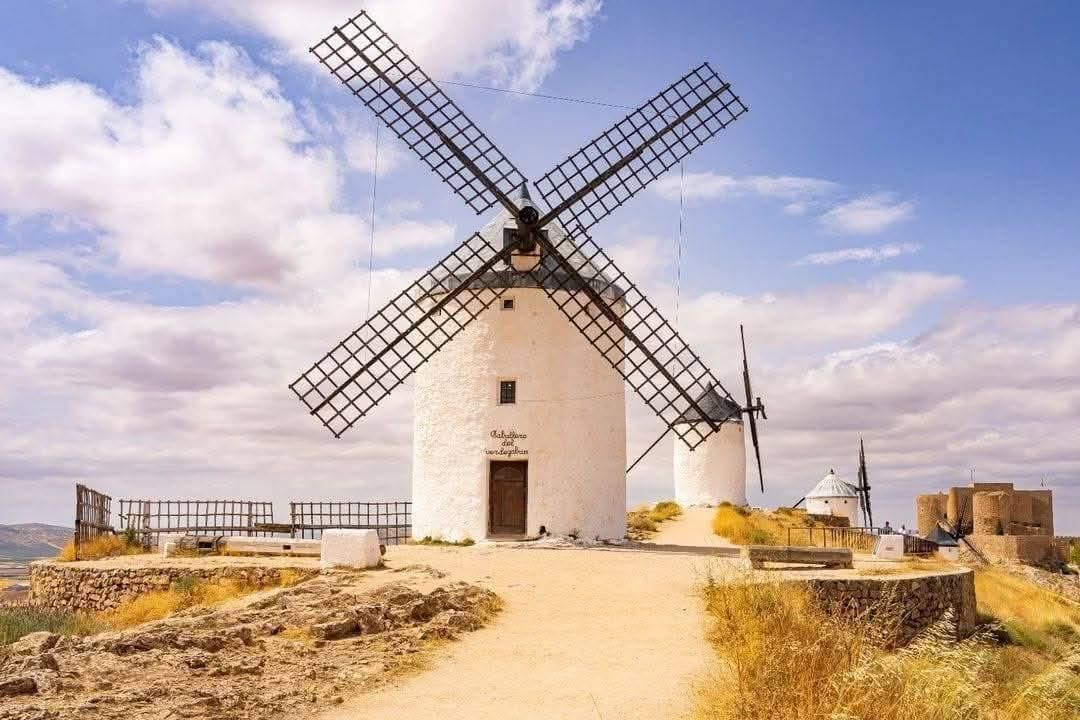
The town of Consuegra is located in the province of Toledo, in the autonomous community of Castilla-La Mancha, and in the kingdom of Spain, The term “Consuegra” is derived from the ancient pre-Roman city of Consabura which means “the confluence of the Sabo river”. This is the ancient name of the Amarguillo river, and it appears to be a very ancient hidrónimo that comes from ancient Europe.
The town is well serve by roads such as the autovía de los Viñedos or CM42 road that takes you to Toledo, Madridejos; then the Autovía del Sur or A-4 takes you to Alcázar de San Juan y Tomelloso. It is 63 km from Toledo , 69 km from Ciudad Real, 131 km from Madrid along the Autovía de Andalucía, the one who will bear by Madridejos, onto the CM 42, direction Toledo. ,We came here from our rental house in Las Majadas (see post) coming down to Cuenca and taking the A40 or Autovia de la Meseta Sur dir Ocaña on exit/salida 62 intp the A4 or Autovia del Sur dir Tembleque to Madrilejos at exit/salido 121A into the CM42 or Autovia de los Viñedos at exit/salida 59 bear left into the CM400 road dir Consuegra taking the Avenida Alcazar de San Juan to City center,then Calle Diego Rodriguez Diaz continue on Calle Fuentecilla, where you will the windmills and castle to find parking.
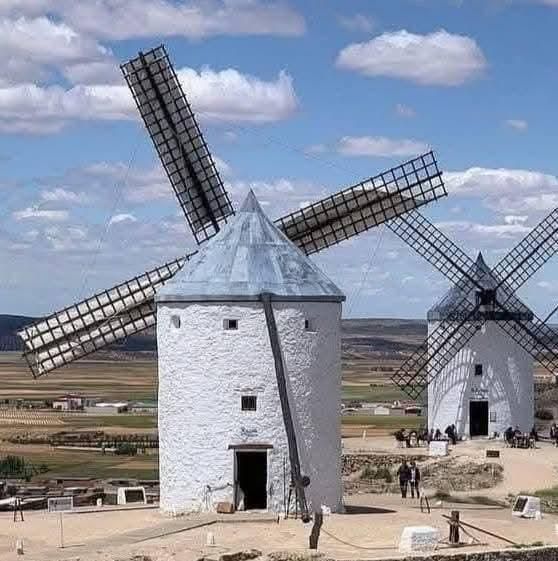
The windmills are lined up on Calderico Hill. They date back to the 19C, although some may be older, even from the 16C. Of the original thirteen, twelve remain, which are: Bolero, which houses the tourist office and the wheat mill; Mambrino; Sancho, which preserves the 16C machinery and is used in the Saffron Festival; Mochilas, recently restored by the town’s workshop school, Vista Alegre; Cardeño, which houses an already uninhabited house; Alcancía; Chispas; Caballero del Verde Gabán, which has numerous versions of Don Quixote; Rucio, which has a wine exhibition; Espartero, which has an exhibition of Toledo crafts; and Clavileño, with photographs and furniture from Andorra. It was windmills like those in Consuegra that inspired Miguel de Cervantes to write the famous episode of the fight against the giants in “Don Quixote.”
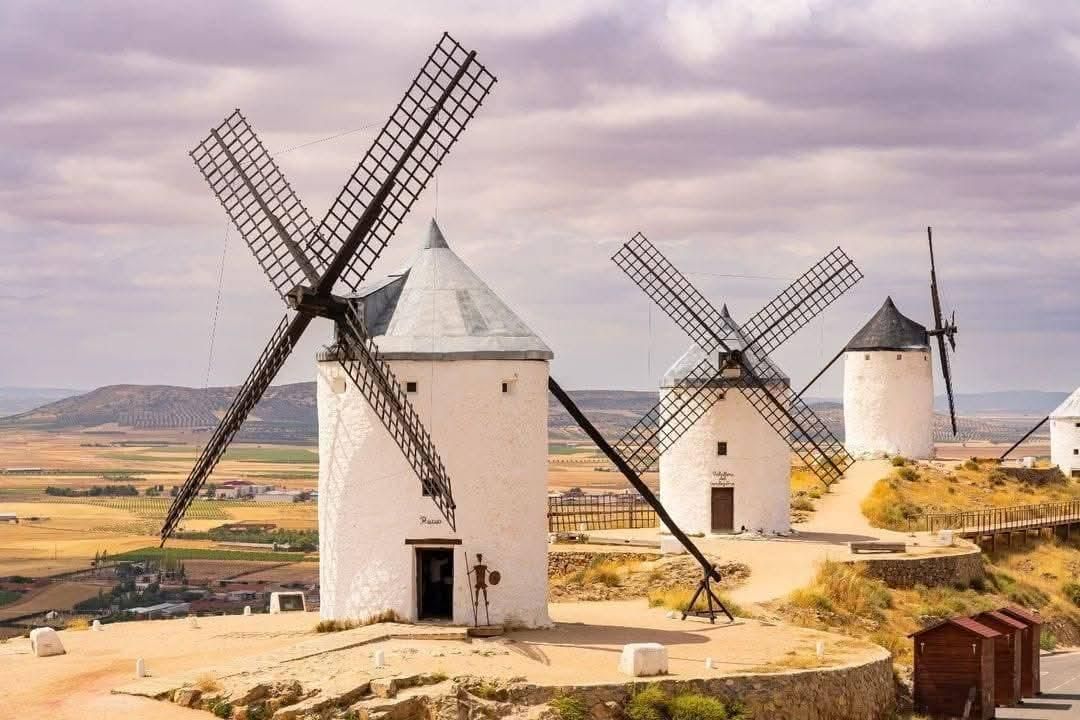
Other things to see here with more time are the castle of La Muela or Consuegra, of Muslim origin but modified and enlarged in the 12C by the Order of Saint John of Jerusalem, and has had its third defensive walls restored in the last decades. On the site where the castle stands, there was a Celtiberian settlement, probably Carpetani. There are historians who maintain that it was the Emperor Trajan who built the fortress, although the first existing documentation places the beginning of its construction during the Caliphate of Córdoba in the 10C. It has a double line of walls, three towers, a keep and an exterior battlement. In 1962 the castle, which as part of the Mendizábal confiscation of separation of church and state of 1836 had passed into private hands, was ceded to the city council. The Church of San Juan Bautista Mudejar style built in 1567 , Church of the Santísimo Cristo de la Vera Cruz began around 1750 in Neo-Baroque style, it was inaugurated on September 15, 1803 , The Parish Church of Santa María la Mayor built in 1723. Single-nave temple, in Mudejar Toledo style, with a porticoed entrance It was originally the church of the Convent of San Antonio de los Franciscans, until the destruction of the first church of Santa María la Mayor by the French in 1812. Later, once abandoned by the Franciscans, it became the Parish of Santa María. The Plaza de España is the ancient Roman Forum where the population met and meets. It houses the Ayuntamiento or City/Town Hall, in Renaissance style, built in 1670 as a granary, joined to this building by an arch is the clock tower. You can also see the “Los Corredores” building, from the 17C, with a beautiful wooden balcony, typically of La Mancha, it was a silo, a grain market and a town hall. It currently houses the Municipal Archaeological Museum, with pieces ranging from the Neolithic to the 19C. The convent of San José, of the Reverend Mothers Discalced Carmelites in 1597. It was erected by testamentary disposition by the Grand Prior of the Order of Saint John, Fernando Alvarez de Toledo, in thanksgiving for the sentence that granted his family the body of Saint Teresa of Jesus, and which was in Alba de Tormes (where she died). It contains a letter from the Saint, and several from San Juan de la Cruz.(Saint).
A bit of history I like tell us that in 1085, Toledo fell to Alfonso VI. It seems that Consuegra had passed into the hands of Castile in 1083. In 1097, the son of El Cid Campeador, Diego, died in the Battle of Consuegra. In this battle, the Castilian armies commanded by King Alfonso VI were defeated by the Almoravids under Yusuf ibn Tasufin, and the castle changed hands again. It was later reconquered by the Christians. In 1150, Alfonso VII handed the castle over to his vassal Rodrigo Rodríguez. In 1183, the town and its surrounding area were donated by Alfonso VIII, with the approval of Pope Lucius III, to the Sovereign Order of the Hospital of Saint John of Jerusalem (Order of Malta). The Order appointed Consuegra as the Grand Priory of Castile and León in La Mancha, taking the castle as its headquarters and granting it the Charter of Consuegra, a copy of that of Cuenca. Notable during this period under its tutelage was the defense after the Battle of Alarcos in 1195. With the Battle of Las Navas de Tolosa in 1212, the area was finally into Christian hands. During the War of the Communities, Consuegra remained loyal to King Carlos I, who granted it the title of Most Loyal. During the Spanish Peninsular War (independance war), on September 22, 1809, the Battle of Consuegra took place against the French army, in which the troops of the Duke of Alburquerque were defeated, the town being occupied by the French, who destroyed the parish church of Santa María la Mayor, and much of the archive of the Order of Saint John, which was in the nave of the Castle, was burned. It was taken by French troops who established a garrison, which lasted until the French surrender on September 22, 1812, with General Francisco Javier Elío in command of the Spanish troops. The disentailment in the 19C caused the Order of Saint John to abandon the town. On March 27, 1927, King Alfonso XIII granted it the title of city, which Alfonso VI had stripped it of following his defeat in 1097.
The Consuegra tourist office on its windmills : https://www.consuegra.es/en/discover/monuments/consuegra-windmills
The town of Consuegra on its heritage : https://aytoconsuegra.es/turismo/
The province of Toledo tourist office on Consuegra : https://www.turismoprovinciatoledo.es/en/consuegra/
The Castilla La Mancha regional tourist office on Consuegra : https://en.www.turismocastillalamancha.es/patrimonio/consuegra-20931/descripcion/
There you go folks, another wonderful nostalgic, sentimental trip to my dear Spain, Do not know when we will be back, we sure will look forward to be back, eventually, Again, hope you enjoy this post on this is Consuegra !!! as I.
And remember, happy travels, good health, and many cheers to all !!!

 Paris1972-Versailles2003