
The Royal Palace of La Granja de San Ildefonso is an 18C palace, summer residence of the kings of Spain since Felipe V of Spain. It is located in the village of San Ildefonso, in the province of Segovia, 80 km from Madrid. In Baroque style, it is surrounded by French gardens and 26 sculptured fountains. It is now open to the public as a museum. I need to tell you more with this update on the castle. Therefore, here is my take on the Royal Palace of La Granja de San Ildefonso, part III !!! Hope you enjoy the post as I.
The brief story goes that Felipe grandson of king Louis XIV of France born at Versailles, baptised at Notre Dame Church of Versailles and move over as bourbon king of Spain under Felipe V. Current king of Spain Felipe VI is a descendant. Of course, been born at the Palace of Versailles and coming over, the need to try to recreate the splendor of the old place was imminent. So he decided to ordered built the palace in the forest around the village of San Ildenfonso. This he succeeded in a smaller scale but just as beautiful. The Palacio Real of the Granja de San Ildefonso was born,
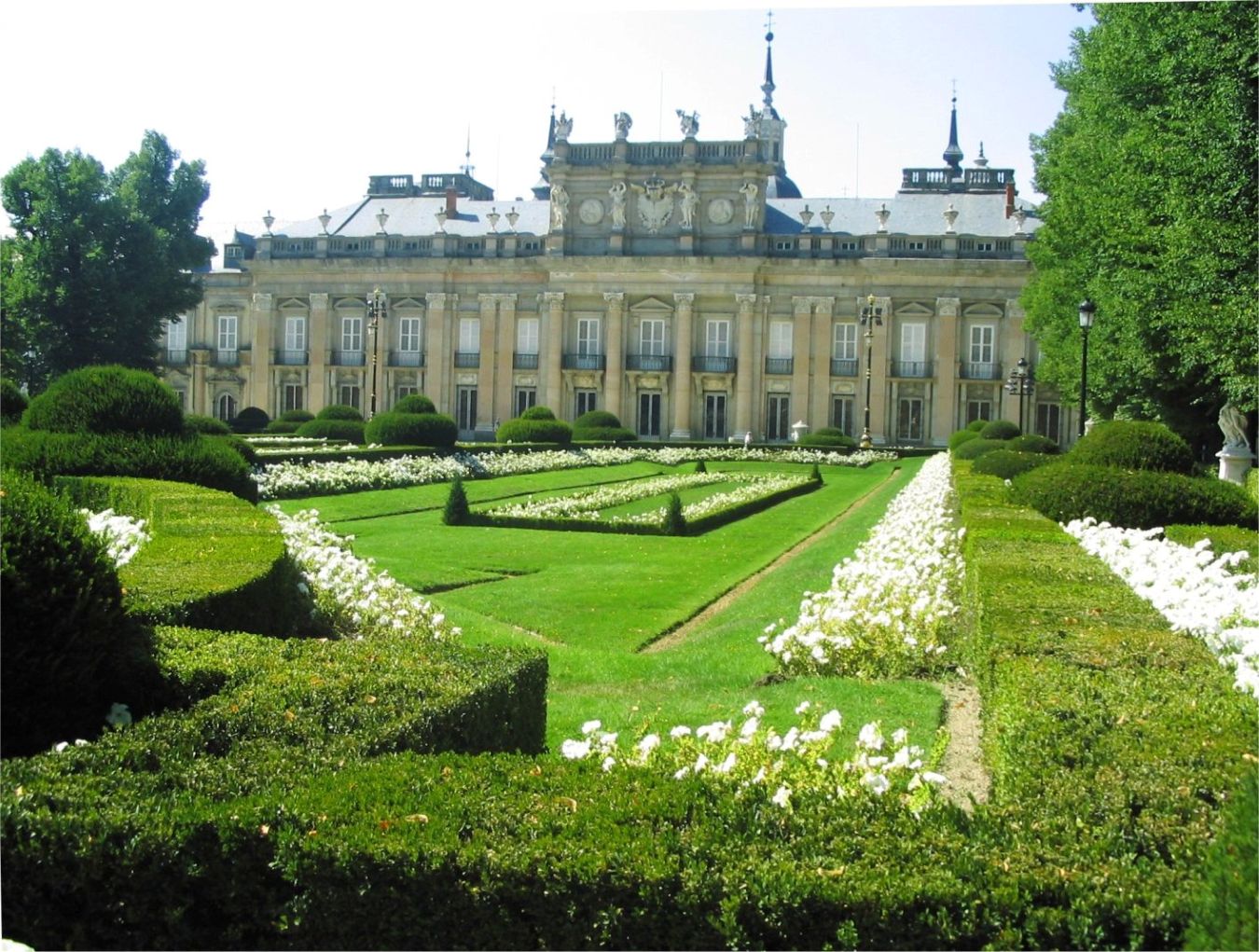
The gardens have more than 12,000 trees in-line, 70,000 trees in total , and 30 km of lawn with 26 fountains. It has a total area of 146 hectares and a high wall of 6 km around the encercle garden. The highest point is at the Ultimo Pino at 1325 meters high and the lowest point is at the Puerta del Vivero. The gardens surround the palace and are one of the finest examples of 18C European garden design. They were designed by the French gardener René Carlier, who used the natural slopes of the hills surrounding the palace to aid visual perspective and as a source of power to make the water flow from each of the 26 monumental fountains that decorate the park. Carlier died in 1722, and his work was continued by his compatriot Étienne Boutelou. Unlike at Versailles, where they had many problems obtaining sufficient water pressure for the fountains, at La Granja, the natural slope of the land was used to achieve a pressure unseen until then, allowing some fountains to reach heights of over 40 meters.
The Monumental Fountains in the palace gardens comprise twenty-six fountains, all based on classical mythology, though fantastical folk tales have always surrounded each sculpture, recounting a mixture of desires, human traits, and foreboding fears. The Fuente de La Selva or Forest Fountain features Pomona and Vertumnus. It consists of a pool divided into four smaller pools. The Carrera de Caballos or Horse Race fountain is composed of the following fountains: the Fuentes de los Caracoles ( Snail), El Abanico ( Fan) , Neptuno (Neptune), Apolo (Apollo), Estanque de la Medía Luna ( Half Moon Pool) ,and Andrómeda fountains. The Cascada Nueva (New Cascade) is located on the main facade of the palace, surrounded by a beautiful parterre or garden, and consists of the Fuente de Anfítrite ( Amphitrite), the Cascada (Cascade), and the Fuente de las Tres Gracias (Three Graces). The Fuente de los Vientos (Winds) depicts the mythological figure Aeolus. It is a small circular pond in the center of which, atop a rock, stands the god Aeolus, crowned and holding a staff. He holds the winds, represented by children’s heads, imprisoned in a large wineskin. The Fuente de los Dragones (of the Dragons) (see pic) consists of two fountains with four large, highly realistic dragons. Around a large circular plaza, where eight streets converge, are situated the Fuente de las Ocho Calles ( eight strrets fountain) representing Neptune, Victory, Mars, Cybele, Saturn, Minerva, Hercules, and Ceres. In the center is a marble pedestal upon which sits a group of figures: Psyche, Mercury, and Zephyr.
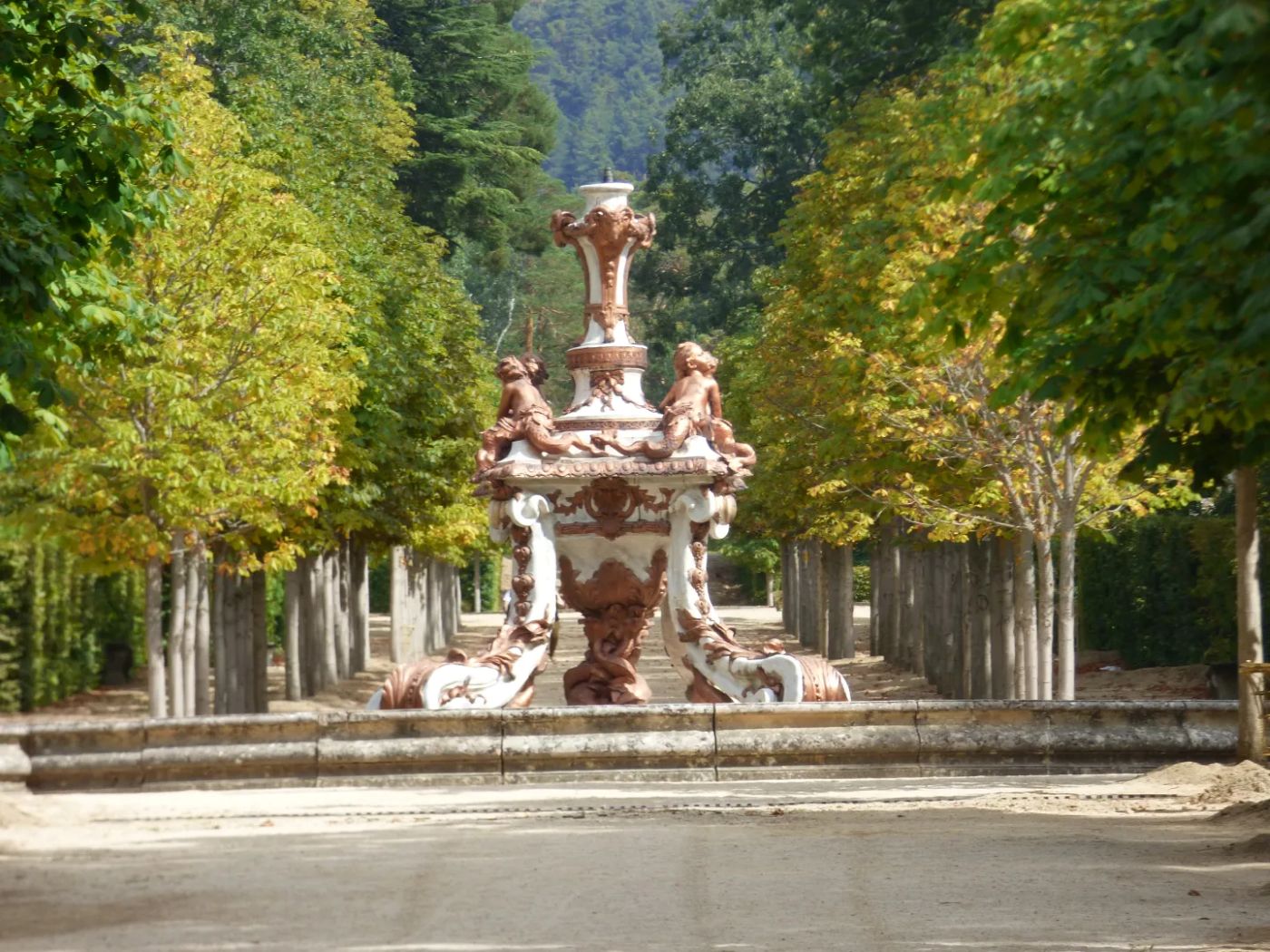
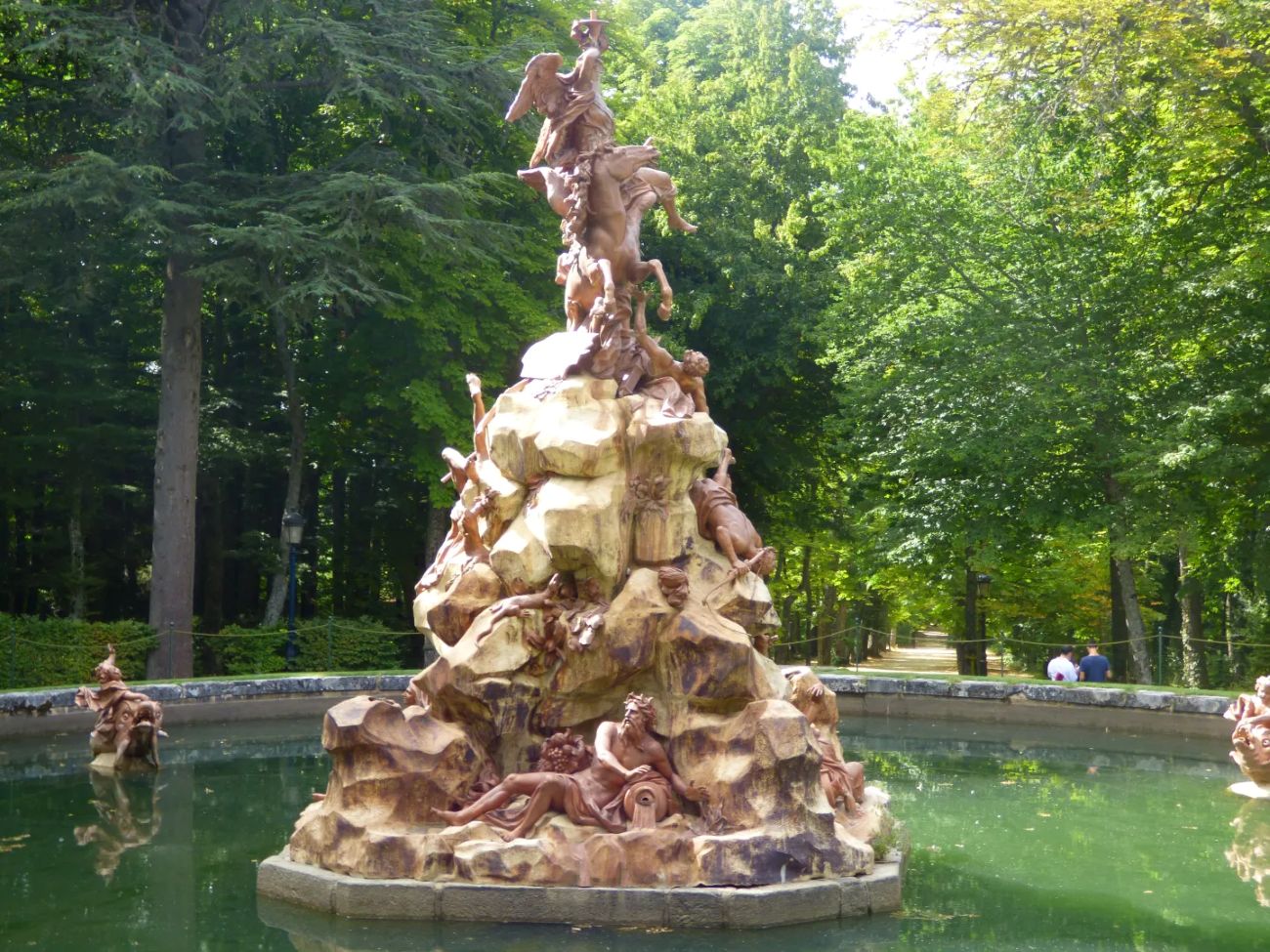
The Fuente del Canastillo (Basket) without a mythological legend, it is nevertheless one of the most striking for its water features. It also has the unique characteristic of spraying water when in operation. From the center of the basket, a jet shoots water to a height of 25 meters. From the edge of the basket, 32 oblique jets emerge, which, with sufficient pressure, propel water beyond the fountain. The Fuente de las Ranas ( Frogs mythological figures: Latona with her children, Apollo and Diana, and farmers. With water features as striking as those of the Basket Fountain, it represents the moment when the farmers are transformed into frogs by Jupiter as punishment for the misdeeds committed against Latona and her children. The Fuente de los Baños de Diana (Baths of Diana) mythological figures: Diana, Actaeon, and nymphs. It is the last fountain to be built. The Fuente de La Fama ( Fame) (see pic). Mythological figures: Fame, Pegasus, Ignorance, Envy. Located to the right of the palace, we can admire the marvelous parterre that precedes it, formed by boxwood and clipped yew trees. The spectacle of this fountain, due to the height the jet reaches, 47 meters, is a true symphony of light and color. At the far end of the Parterre de la Fama ( Parterre of Fame) rises the Fuente de la Fama. In the center of a large circular basin stands a lead boulder, imitating marble. At its summit is Pegasus carrying Fame on his wings, playing the trumpet. Between the hooves of the winged horse are two vanquished warriors, while two Moors lie on the ground. The Guadalquivir, Duero, and Ebro rivers are depicted almost at water level. The Mar (Sea) has a capacity of 216,000 m³, the large lake built in the highest part of the park, from whose waters most of the fountains are fed.
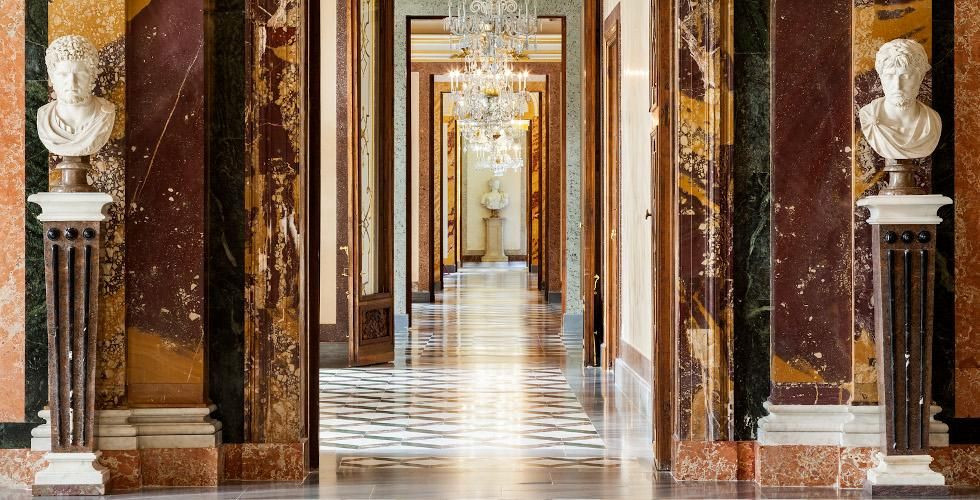
Not in the gardens , of course, but figure one picture should be added here rather than not at all, The Sala de Mármoles o de Europa or the Marble Room or the Room of Europa is the only area of the walls where marble is not the main feature is in the large mirrors. These are the first mirrors of this size made at the Royal Glass Factory. These mirrors also feature elaborate gilded frames in the Rococo style. The ceiling is decorated with gilded stucco on a white background, in the 18C tradition, and has a central medallion depicting “The Rape of Europa.” According to Greek myth, Zeus, transformed into a bull, abducted a Phoenician woman named Europa to take her to Crete. Europa’s gaze is directed towards her companions, who contemplate the scene with surprise. Before the throne, a seated matron extends a garland of flowers, and on her left knee, a child attempts to thrust the dart of love into the bull’s chest. At the head of the procession, a cherub carries Hymen’s torch. Above, winged children try to protect Love’s boldness, covering it with a green curtain. Ultimately, this is an allegorical way of explaining the Phoenician roots that lie at the origin of European culture. Finally, it should be noted that on either side of the hall’s doors are pilasters with marble busts representing Diana and Roman emperors.
The Natural Heritage of Spain on the gardens of the Royal Palace: https://www.patrimonionacional.es/en/node/1549
The Castilla y Leon region tourist board on the palace: https://www.turismocastillayleon.com/en/art-culture-heritage/monuments/palaces/royal-palace-la-granja
The town of San Ildefonso on the Royal Palace : https://www.lagranja-valsain.com/ayuntamiento/concejalias/concejalia-de-cultura/equipamientos-culturales-en-el-municipio/palacio-real-de-la-granja/
The San Ildefonso tourist office on the gardens fountains of the Royal Palace: https://www.turismorealsitiodesanildefonso.com/punto-de-interes/jardines-del-palacio-real-de-la-granja-y-sus-fuentes-monumentales/
The Spain National Tourist office on the gardens of the Royal Palace : https://www.spain.info/en/places-of-interest/san-ildefonso-farm-gardens/
There you go folks, a wonderful palace indeed. A really nice place to visit and one I would have no problems in a repeat. Again, hope you have enjoy the post on the Royal Palace of La Granja de San Ildefonso, part III !!! as I
And, remember, happy travels, good health, and many cheers to all !!!

 Paris1972-Versailles2003