
I take you back to my dear Madrid !! love it !! I like to continue the saga of my dear Madrid with new pictures from my cd rom vault that should be in my blog for you and me, This is again my lost walking trails of wonderful sublime Madrid, Therefore, let me tell you about curiosities of Madrid, part XV !!! Hope you enjoy the post as I.
The Plaza de la Cruz Verde is a small, secluded square in the Madrid of the Habsburgs next to Calle Segovia ,and in La Latina district. A quiet, steep square of medieval origin presided over by the monument of the so-called Fuente de la Cruz Verde or fountain of the green cross. The name of the Green Cross has its historical origin in a wooden cross painted green as a sign that indicated the places where the executions of the Inquisition were carried out. The five-spout fountain was built in 1850. The monument benefits from the old façade of the garden of the convent of the Bernardas del Santísimo Sacramento as a pillar. The complex consists of three sections, joined by a granite plinth. The central section, which is higher, features a Madrid coat of arms of the Oso and Madroño or the Bear and the Strawberry Tree, carved in white stone, beneath which appears a plaque with the following inscription: “During the reign of Mayor, His Excellency the Marquis of Santa Cruz. Year 1850.” Above its lintel rests a statue of Diana, the virgin goddess of the hunt and protector of nature, dressed in a short tunic. It is made of white marble, as are the two mythological dolphins at her feet. The sculptural group is flanked by two ornamental white stone pine cones. The fountain has five spouts on its front ; three of which are located in the central section, and one on each side. Its water is deposited in three basins: the main one is located at the front and the other two on each side. All of them are made of granite and have a rectangular floor plan. The Plaza de la Cruz Verde is a square of ochre facades dotted with lanterns and balconies, with a cobbled area with benches and trees and where there is a popular terrace from which you can see the building where the architect Ventura Rodríguez, an 18C architect, lived for a time. The square’s name alludes to the emblem of the Inquisition, a green-painted cross, which led the processions held on the eve of an auto-da-fé (act of faith) and symbolized the hope of eternal salvation for heretics reconciled with the Catholic Church. This cross was carried by members of the Inquisition to the site where the auto-da-fé was to be held the following day. During that night, prayers were said, preparations were completed, and the pyre was prepared, while the inquisitorial militia stood guard. At the end of the auto-da-fé, a procession returned the green cross to its sanctuary.
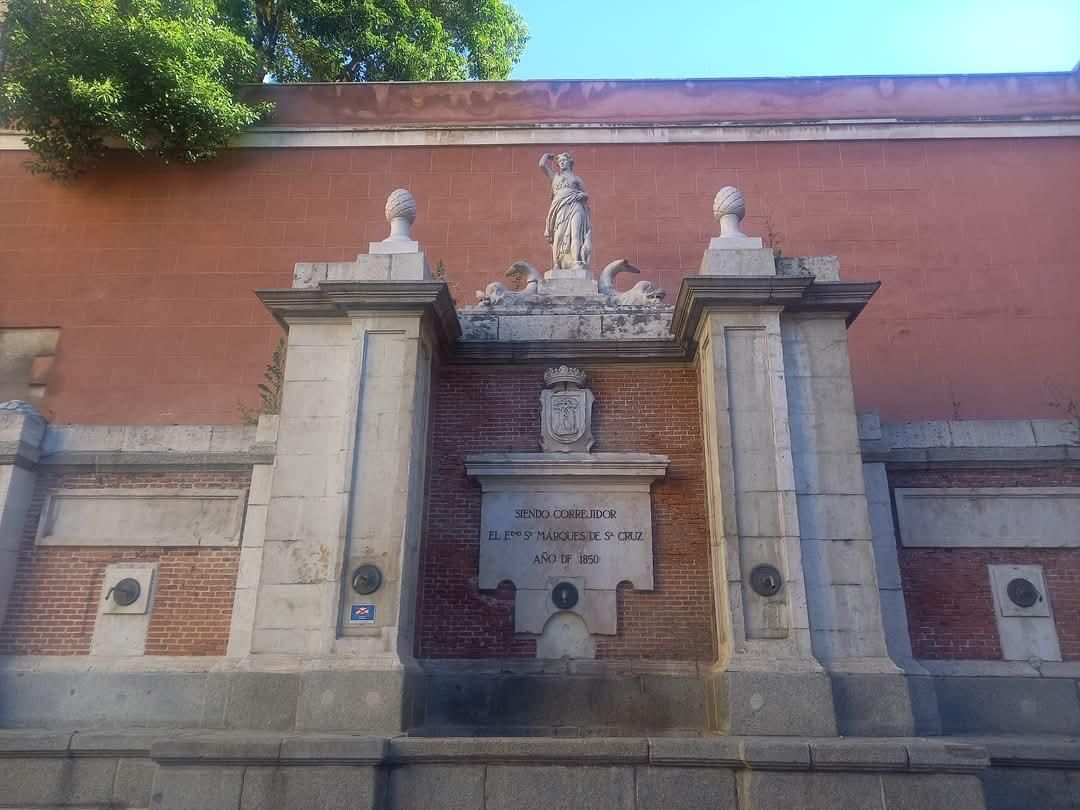
The Madrid tourist office on the fountain green cross in plaza de la Cruz Verde : https://www.esmadrid.com/en/tourist-information/fuente-de-la-cruz-verde-diana-cazadora
At No, 7 Calle Sacramento in the Centro district, beneath modern red brick buildings, lies the entrance to the Huerto de las Monjas or Nuns’ Garden, also known as the O’Reilly Palace Garden. It is a small interior garden with several culinary trees and a striking fountain. Formerly used as a vegetable garden by the Bernarda sisters (17C), this corner evokes the atmosphere of the Golden Age of Madrid. The garden has two entrances, one from Calle Sacramento, and the other from Calle Rollo. One of the walls separating the garden from the exterior faces Plaza de la Cruz Verde, where the Diana the Huntress Fountain is located. The former O’Reilly Palace is now the Madrid City Council’s Treasury offices. The convent was founded by Don Cristóbal Gómez de Sandoval, better known as the Duke of Uceda and a favorite of Felipe III, who commissioned its construction in 1615, very close to his own palace. Unfortunately, the convent and its church were destroyed during the Spanish Civil War. Rebuilt in the 1940s, the Bernardines continued to live there until the convent was demolished in 1976, to be replaced by several modern apartment blocks, although there was no intention of eliminating the garden. The fountain in the center it’s a bronze fountain composed of four cherubs called the “Fountain of the Prioress.” Apparently, the fountain comes from the “El Castañar” estate owned by the Duke and Duchess of Montellano in Toledo, and when they moved to their palace on Paseo de la Castellana, they took it with them. The fountain was cast in France, as a plaque tells us, in the “Fonderies D’Art du Val D’Osne-58 bd. Paris.”
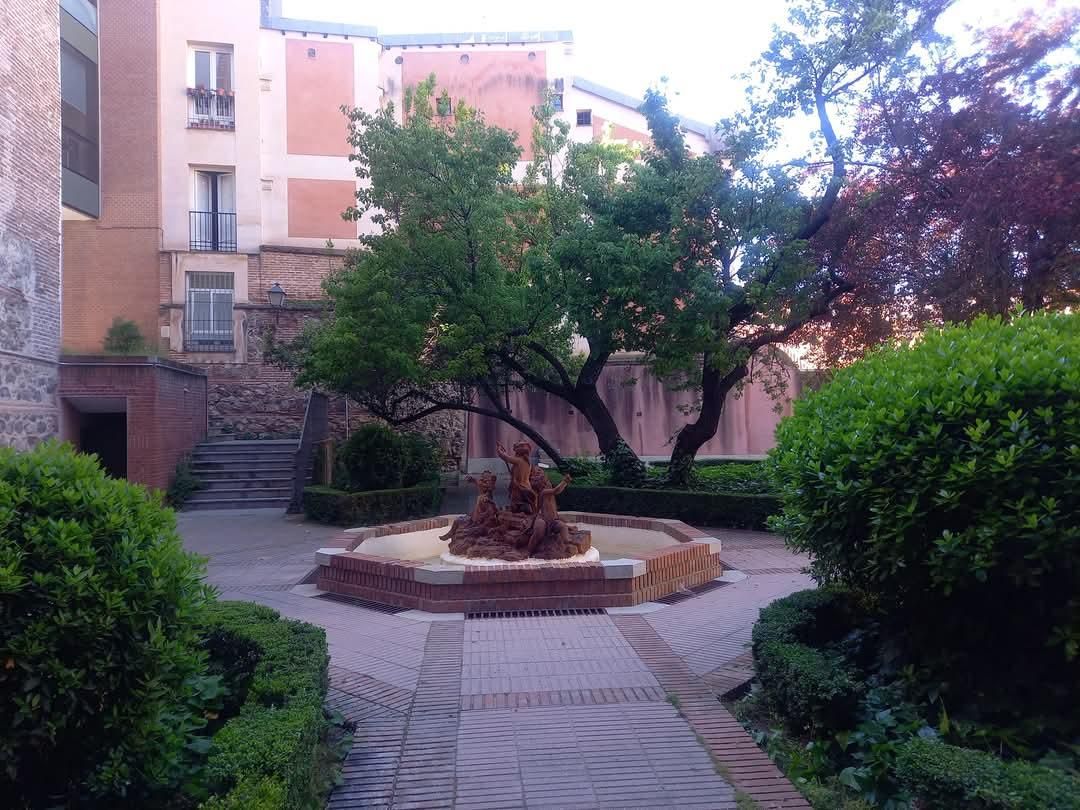
The Madrid tourist office on the Huerto de las Monjas : https://www.esmadrid.com/en/tourist-information/huerto-de-las-monjas
There you go folks , another wonderful nostalgic, sentimental trip to my dear Spain, A love affairs with my Madrid, as do not know when we will be back, we sure will have this trip in our hearts forever, Again, hope you enjoy this post on curiosities of Madrid, part XV !!! as I
And remember, happy travels, good health, and many cheers to all !!!

 Paris1972-Versailles2003