
I look back in my blog and saw some nice older pictures in my cd rom vault not in , and they should be for you and me, I have taken nice walks on some of these wonderful streets of always in a wonderful city like Madrid, heavens! This is the city that I spread my wings sort of speak when at an early teen in town, and eager to learn all of it, took me to many places, Some more than others but all wonderful memories of youth that been lucky to relive for many years and introduce them to my family,friends, and now those following my blog, Therefore, here is my new take on the streets of Madrid ,part IX !!! Hope you enjoy the post as I.
The Carrera de San Jerónimo runs between Puerta del Sol and Plaza de las Cortes (Palace of the Spanish Parliament or Congreso de Diputados- see post). It was once called the calle Camino del Sol. The street has two distinct sections, the first runs from the Puerta del Sol, almost parallel to Calle de Alcalá until it reaches Plaza Canalejas, and from there it heads towards San Jerónimo el Real (see post), with the street ending at Plaza de las Cortes. You see the pic at end the Casa de Don Tomás de Allende. It is an ancient road leading to the Jenónimos Monastery, on the other side of the orchards known as the Prado de los Jerónimos. The first buildings were documented as early as the 16C, and a sewer was built in 1618. The inn, La Fontana de Oro, became popular as a meeting place and political gathering, as reflected by Benito Pérez Galdós in his novel La Fontana de Oro. On the corner of the neighboring Calle de la Victoria, the Hotel Embajadores prospered. The Lhardy restaurant (see post), located at no 8 on Carrera de San Jerónimo, was opened in 1839 by the Frenchman Emilio Huguenin Lhardy. It is considered one of the first and oldest restaurants in Madrid, at least as it is known today, that is: a menu with a price for each dish. In 1855, the Jijona confectioner, Luis Mira (see post), opened Casa Mira (see post) at no 30. On the second stretch of the street, there were several noble homes and mansions, including that of the Marquis of Santiago (where the Casino de Madrid resided for some time), the house of the Duke of Tamames, and that of the Marquis of Valdegena. At no 24, the Cerveceria Inglesa or English Brewery stood in a building that would be demolished to build the Reina Victoria Theatre (see post). Directly opposite was the Café de la Iberia. At no 35 is the Palace of the Marquis of Miraflores. The first public screening took place on the ground floor of the Hotel Rusia on this street in the Lumière brothers’ cinema , as a screening was given for the press and special guests, Perhaps the most illustrious residents was Francisco de Goya, who lived in a house belonging to the Marchioness of Campollano, between 1778 and 1779.
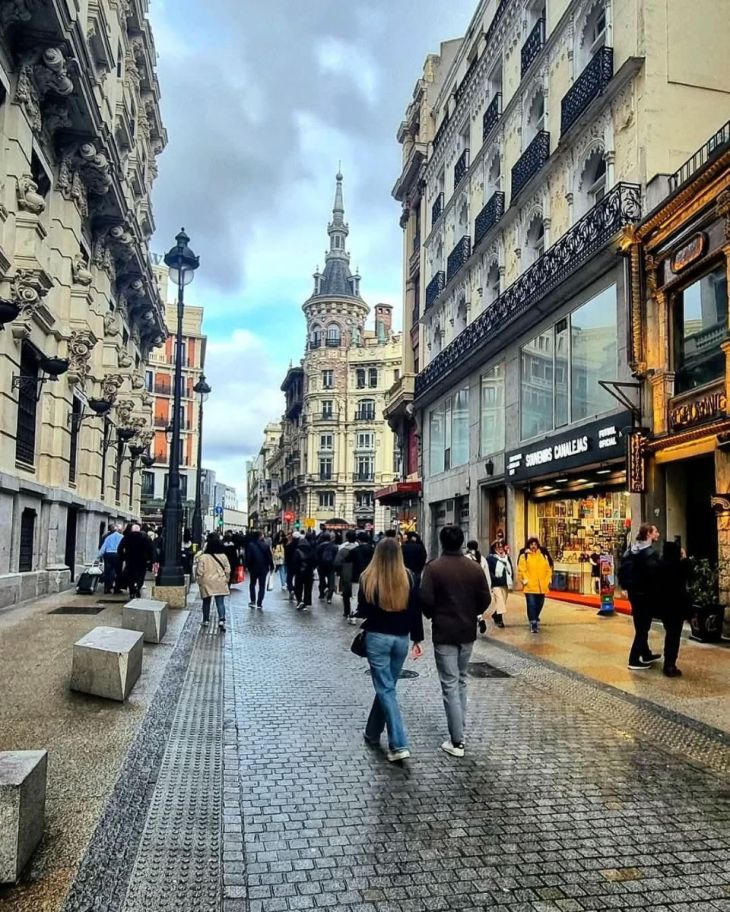
The Gran Via metro station this time by the corner of Calle de la Montera and Calle Fuencarral (see pic) has been refurbished in 2021 with a replica of the original entrance built at the start of the 20C, providing access to the first line of Madrid’s new metropolitan network, North – South. In Gran Via station, on the second intermediate level, there is also a small museum exhibiting the archaeological remains uncovered during the excavation and expansion of the station. The Gran Vía is entirely located in the Centro or city center district, it extends over the districts of Justicia, Parlamento, Sol, Universidad and Palacio, for a total length of 1 300 meters (4290 feet). It comprises three sections, the first of which extends from Calle de Alcalá to Plaza San Luis, the second to the Plaza Callao and finally the third to the Plaza de Espana.

The plaza de Chueca square, formerly called San Gregorio Magno Square, is a small pedestrian area in the Justicia neighborhood, Centro district of Madrid, It is framed by Calle Gravina and Calle Augusto Figueroa , on one side of the start of Gran Vía. Dedicated since 1943 to the Madrid composer Federico Chueca, it gives its name to the entire neighborhood. This talented composer composed several valuable musical works, including zarzuelas and operas. Born in 1846, he was 100% Madrileño or locals ; just by reading the titles of his compositions, you’ll understand why In the first half of the 19C and part of the previous century, the space occupied by the buildings that enclose the square and its surroundings were occupied by La Galera, a women’s prison brought to this area from previous locations, and the orchards of the Dukes of Frías. They made them the streets very suitable for the immoral and treacherous scenes that Don Ramón de la Cruz and Don Francisco Gregorio de Salas aspired to poetize in their farce. The Plaza de Chueca is a short walk from the Mercado San Antón market, is located in the heart of the neighborhood it takes its name from, the Barrio de Chueca, now known in the city as the “gay district.” The square blends perfectly into the neighborhood’s atmosphere: in addition to the metro exit, there are several tapas bars, a couple of small shops, and a few restaurants with outdoor seating… Easy by metro Chueca Line 5, Between Plaza de Chueca and Fuencarral and Hortaleza streets, there is a sprawling neighborhood of quiet little streets whose commercial activity surprises visitors. The epicenter of the gay scene, the neighborhood has opened up to all kinds of offerings, becoming one of the most visited areas, both by locals and visitors from elsewhere.
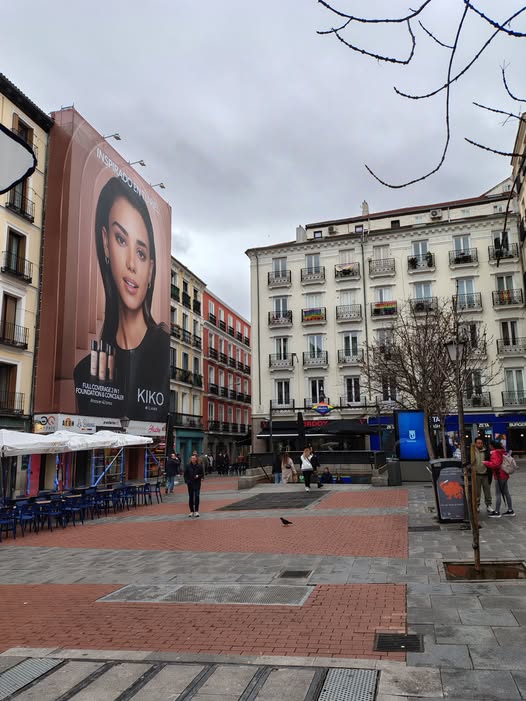
The Sol is a multimodal station located beneath the Puerta del Sol, in the neighborhood of the same name in the Centro district. Underneath you have the lines 1, 2, and 3 of the Metro, and C-3 and C-4 of the Cercanias or commuter rail network, converging at this station. The platforms of Line 1 entered service in 1919 when the first metro section in the city opened between Sol and Cuatro Caminos. The Line 2 station was added in 1924, located above and perpendicular to Line 1. The station for Line 3 was added in 1936, located more or less at the same level as Line 1 and also perpendicular to Line 2. The access is done by the Puerta del Sol Lobby for both metro and Renfe commuter trains, At exit Puerta del Sol, 7 go up to corner of Calle Carretas , Calle del Carmen, At exit Puerta del Sol, 12 go up corner of Calle del Carmen , and Calle de Alcalá, At exit Puerta del Sol, 13 go up at corner with Calle Montera, The commuter trains at Sol go up at Puerta del Sol, 5 corner with Calle de Alcalá and Carrera San Jerónimo, Puerta del Sol Elevator 13 corner with Calle Montera, The main lobby go out at Calle Mayor with Puerta del Sol, 8 corner of Calle Mayor 2 and Calle Arenal with elevator, Puerta del Sol, s/n corner of Calle Mayor, On the Preciados Lobby go up on Calle Preciados , 3, The Shopping Center Open according to shopping center hours Direct access to El Corte Inglés (see post).
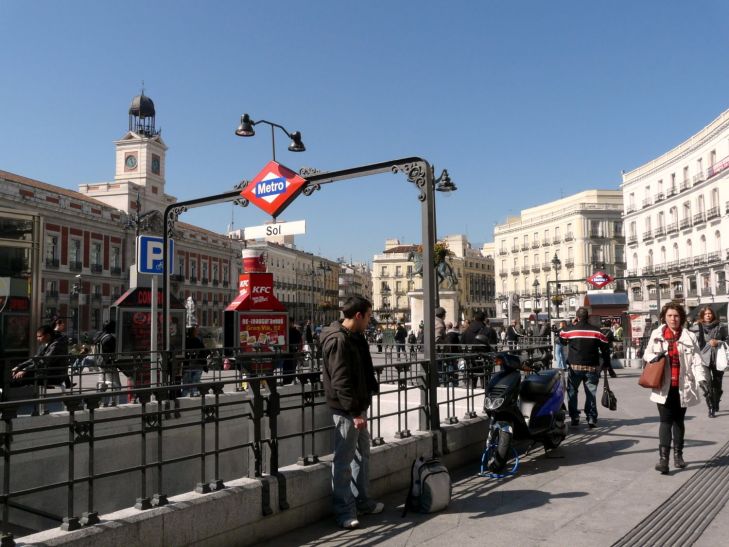
The official Metro of Madrid (see lines 1,2,and3) Sol : https://www.metromadrid.es/en/linea/linea-1
The Madrid tourist office on the Puerta del Sol: https://www.esmadrid.com/en/tourist-information/puerta-del-sol
There you go folks , a bit more of architecture and history wonders on the streets of my dear Madrid. Walking any city is great and in Madrid it is sublime !!! Again, hope you enjoy the post on the streets of Madrid ,part IX !!! as I
And remember, happy travels , good health, and many cheers to all !!!

 Paris1972-Versailles2003