
I will tell you about a town that should have been in my blog before, but so much to see in my dear Spain had left it out until now, Found me a couple pics from my cd rom vault that should be in my blog for you and me. I take you to Torrelaguna, a quant historical town with nice things to see, me think. Therefore, this is my take on this is Torrelaguna !!! Hope you enjoy it as I.
The town of Torrelaguna is in the Comunidad de Madrid region in my dear Spain, It is part of the Sierra Norte area, The town is 66 km from Madrid, 48 km from Guadalajara, 117 km from Segovia, and 55 km from Alcalà de Henares. It is connected to the A-1 autovia, the northern highway, by the N-320 national highway, which runs for the mere 9 km that separate it from this main communication route and, surrounding the town, heads south towards Talamanca de Jarama and Guadalajara. To the north, it is served by the M-131 regional highway from El Berrueco and the M-102. I came here from Madrid taking the beltway M30 to exit/salida 25 to connect with the outer beltway M40 and get off at exit/salida 1 continue on this road next to the M40 to connect with the A1 by Venturada exit/salida 50 take the road N320 to Torrelaguna.
The Parish Church of La Magdalena, Gothic, it is one of the best examples in the Community of Madrid. It was built on the site of an earlier church. Among them, the main altarpiece stands out, from 1752, in the Churrigueresque style. Its construction spanned from the early 15C to the first quarter of the 17C. It has a basilica plan with three naves and five side chapels. The altarpieces are Baroque and Plateresque. The most notable among them is the Churrigueresque altarpiece on the main altar, To the left, on one side, is the so-called “Christ of Cisneros,” donated by the Catholic Monarchs, as well as a Plateresque tomb and the remains of the poet Juan de Mena, who belonged to the allegorical-Dantesque school of the Castilian pre-Renaissance and is best known for his work Laberinto de Fortuna. To the right, another side is presided over by an altarpiece with a canvas depicting Our Lady of the Rosary. In front of the altarpiece is the tombstone of Alfonso Jiménez, father of Cardinal Cisneros.
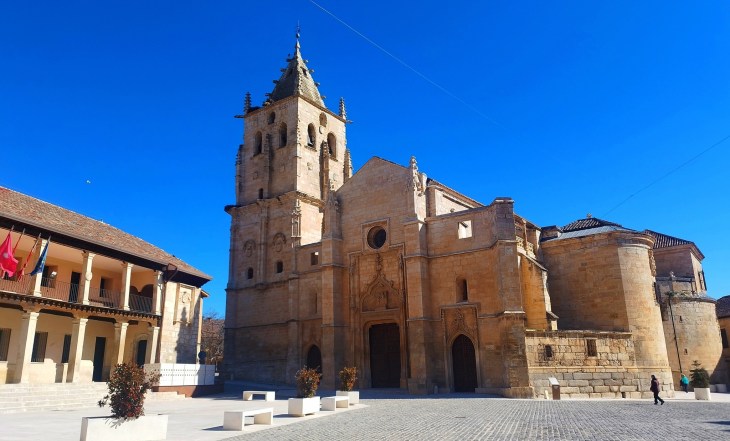
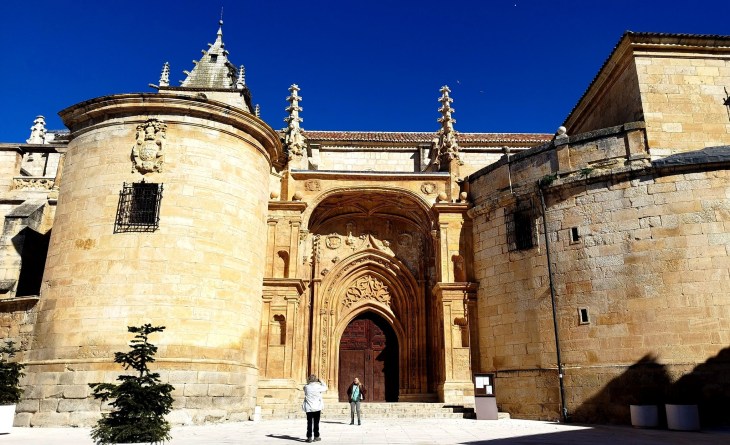
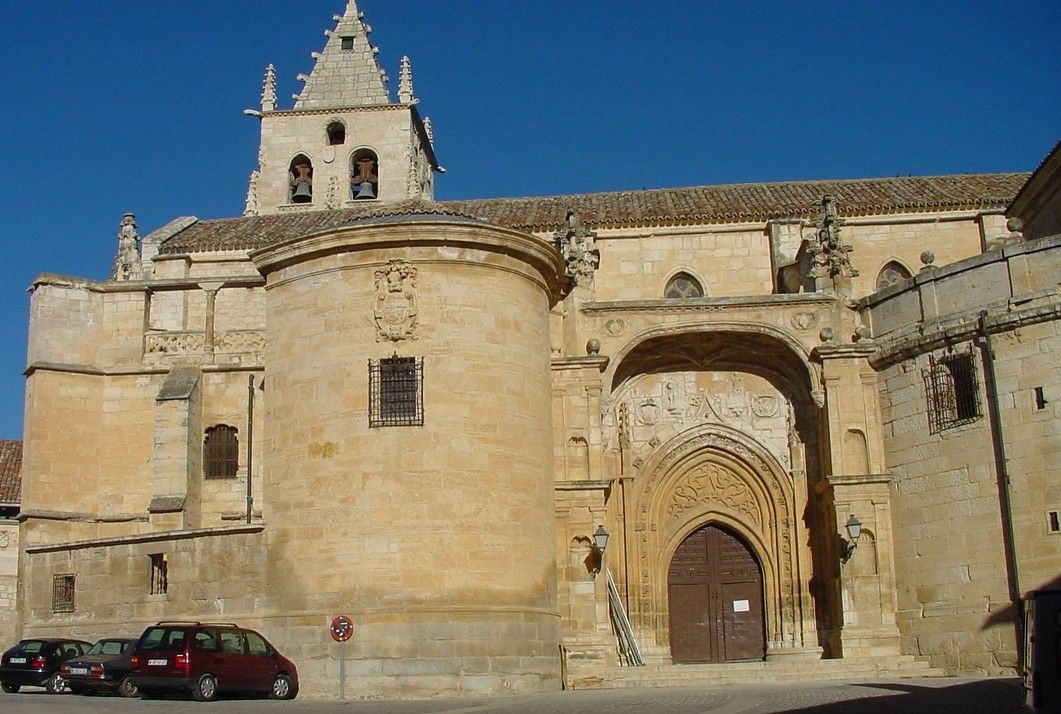
At the foot of the temple and attached to the north wall, stands the church tower, and next to it is the main portal, divided into three sections separated by buttresses. The side openings are pointed, and the central one has a basket-shaped arch. The decorative theme represents the Imposition of the Chasuble on Saint Ildefonso. The south portal, of the Resurrection or Easter, is set back between the two chapels from the 16-17C, and reflects the characteristics of Hispano-Flemish architecture of the late 15C. It follows the pattern of a pointed arch framed by a larger arch with an ogee crown and decorated with fleurons and flamboyant geometric motifs. Its iconography, much deteriorated, reflects the theme of the appearance of the Risen Christ to Mary Magdalene.
Inside, the chancel is divided into three parts: in the central part there is a large Baroque altarpiece from the second third of the 18C, made of gilded and polychrome wood, resting on a stone plinth. It has a bench, a body with three sections and an attic in the shape of a half-dome. In the central section, a large niche houses the sculpture of the patron saint of the church, Maria Magdalena penitente, made in the second third of the 18C. In the side sections there are two other niches, which house the images of S. Isidro Labrador (left) and Santa Maria de la Cabeza (right). The altarpiece was donated by D. Pedro González, Bishop of Ávila, from Torrelagunas. You will be able to see the Baptismal Chapel. 16C. This is a simple rectangular chamber covered with a large vault of tiercerons and ligatures. In the center is the late-Gothic 16C stone baptismal font. Fragments of old altarpieces are placed on the walls as decoration. The Chapel of the Assumption. Founded by Ana Bernaldo de Quirós and built in the 17C in the Baroque style. It has a square floor plan and is covered by a dome on pendentives richly decorated with coats of arms. The chapel’s canvas depicts the theme of the Assumption. The Chapel of San Gregorio, founded by the inquisitor Gregorio Vélez, was built between 1540 and 1544. It is accessed through an ornate Plateresque arch. It has a rectangular floor plan, covered with a star-shaped vault, and has a small polygonal chancel. On the north and west walls, there are two arcosolia with similar characteristics. The tombs and the beautiful polychrome wooden altarpiece are particularly noteworthy. The Chapel of the Annunciation. Dating from the late 16C, it has a Greek cross layout with undeveloped arms and is covered by a dome. It consists of a sacristy, a small upper choir stall, and an underground crypt containing the remains of the founder, Fernán López de Segovia, whose monument is in the form of an arcosolium. The front of the altar is covered by a huge canvas of the Annunciation. Liturgical vestments are also on display. The Chapel of San Felipe. Founded by Doña Petronila de Pastrana in 1626, it has a square layout and is covered by a dome. The large altar canvas, depicts the martyrdom of Saint Philip. The funerary monument of the founder and her husband, Felipe Bravo Daguayo, opens into the south wall of the chapel in the form of a niche.
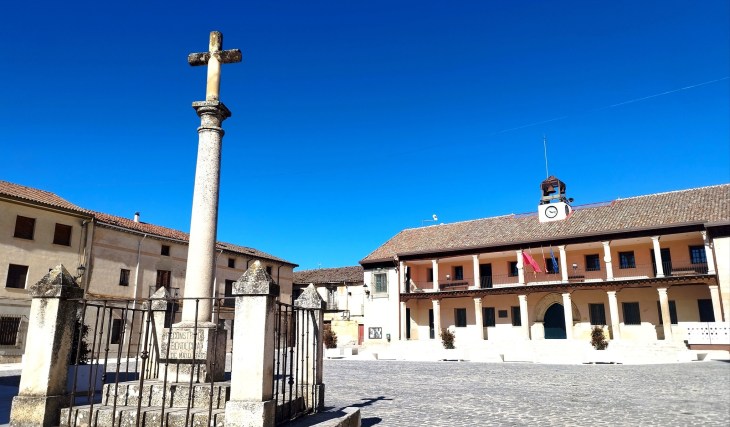
The ayuntamiento or City/Town Hall, former granary was founded by Cardinal Cisneros, one of the most powerful religious figures during the time of the Catholic Monarchs, in 1514 to serve as a granary or grain storehouse during times of scarcity. Its construction, with Renaissance characteristics, included some Gothic elements, such as the entrance door. The interior of the building, with a rectangular floor plan and a gabled roof, has been completely modified. The façade is divided into two porticoed levels preceded by an access staircase and is framed by a pair of sturdy bodies to the right and left. In the upper part of the right-hand body, we find a plaque with the cardinal and archiepiscopal coat of arms of Cisneros and the inscription that proves that the work was promoted by the Cardinal. In addition to being a granary, over time the building has been used for different purposes, such as City hall, prison, primary school, library, and telegraph station. It currently houses the City Hall offices.
Other things to see here are the Abadía de las Madres Concepcionistas Franciscanas Descalzas or Abbey of the Barefoot Franciscan Conceptionist Mothers: it was an abbey for women, from the 16C and after the Council of Trent. Of note are the chapel with its unique Plateresque doorway, from the 16C, and the Renaissance mausoleum of the founders, from the same century. The Ermita de Nuestra Señora de la Soledad or Hermitage of Our Lady of Solitude: it dates from the 14C and was a shrine, called the True Cross. It is Gothic and Baroque in style. It was during the 18C when it became a hermitage-sanctuary of the patron saint of the town. The Salinas Palace: only the façade of this Renaissance palace remains, which is considered the predecessor of that of the University of Alcalá de Henares. The old Wall only a few remains remain, such as entrances of what was a defensive wall and delimiter of the town’s charter, of medieval origin. The only entrance that remains of the wall is the Puerta del Cristo de Burgos, According to tradition, the patron saint of Madrid, San Isidro Labrador, and Santa María de la Cabeza were married in Torrelaguna at the beginning of the 12C.
A bit of history tell us that the origins of the current population are in the independent village of the city of Uceda (province of Guadalajara) that was created when citizens of said population established a farm in the current location of the town to take advantage of the fertile plains at the foot of the mountains. Despite its entirely Castilian appearance in name, it could actually be a hybrid between tower and the name of the Berber tribe of the Laggūna, since throughout the region of the Middle Mark, the Muslim military presence was mainly made up of warriors of this origin, who were grouped by tribes and who settled forming agricultural colonies, merging over time with the primitive Hispano-Visigothic population. During the Reconquest, the population was grouped in the Magdalena neighborhood, which had a watchtower, and the settlement was walled around the 10C, and 11C. In 1085, King Alfonso VI of León conquered the town from the Arabs, and it was incorporated into the domains of the Archbishop of Toledo. In 1390, King John I of Castile and Archbishop Pedro Tenorio of Toledo named Torrelaguna a Free Town, separating it from Uceda. In 1539, Carlos I granted it judicial autonomy in the first instance and its own local charter, due to its non-participation in the War of the Communities of Castile. His son Felipe II sold the town’s manorial jurisdiction to its residents, and in 1749, Carlos III granted it the status of villa or town. During the Peninsular War (so aka Independance), Torrelaguna was sacked by French troops. They destroyed a large part of the walls that had protected the town since the Middle Ages, and they also burned and looted the Franciscan convent, of which only the bell gable remains today. The Spanish Civil War caused considerable damage to town’s monumental heritage.
The town of Torrelaguna on its history : https://torrelaguna.es/historia_torrelaguna/
The Torrelaguna tourist office on its heritage (click Que Ver) : https://turismo.torrelaguna.es/#
The Torrelaguna tourist office on the church Saint Mary Magdalene : https://turismo.torrelaguna.es/iglesia-de-santa-maria-magdalena/
The Comunidad de Madrid regional tourist office on Torrelaguna : https://www.comunidad.madrid/en/cultura/turismo/torrelaguna
The official Sierra Notre de Madrid on Torrelaguna : https://www.sierranortemadrid.org/pueblo/torrelaguna/
There you go folks, another dandy find in my dear Spain ,and glad found me pictures to do this post. Again, hope you enjoy the post on this is Torrelaguna !!! as I.
And remember, happy travels, good health, and many cheers to all !!!

 Paris1972-Versailles2003