
This one came out of the hat or as I said, from my cd rom vault and it should be in my blog for you and me, Another emblematic monuments on the off beaten path of my dear Madridand on a nice old neighborhood , a wonderful architecturally but hugely historical monastery. Therefore, let me tell you a bit on the Convento de las Comendadoras and Parroquia Santiago el Mayor of Madrid !!! Hope you enjoy it as I.
The Convento de las Comendadoras y parroquia de Santiago el Mayor or the Convent of the Comendadoras and Parish of Santiago el Mayor was founded in 1584 by Don Íñigo Zapata Cárdenas and his wife as the headquarters of the Order of Santiago in Madrid, but construction did not begin until 1697, The most notable element of the complex is the dome, which rests on large chamfered pillars and pendentives decorated with the Cross of Santiago. The entrance is through a narthex with a tripartite portico of semicircular arches. The economic situation caused the work to proceed slowly, but by 1675 the church was almost finished, lacking the roofs. In 1745, the new Sacristy of the Knights, a space of great beauty and meticulous 18C classicism. Around 1753, Francisco Sabatini restructured the convent, uniting the various houses into which it had been distributed until then.The Convent is located in the Plaza de las Comendadoras (see street post). It is considered the first convent built in the city, and the only one that is fully preserved.It was not until 1697 that the true foundation took place with the arrival from Valladolid of several Commandery nuns of the Order of Santiago by order of king Felipe IV. The first nuns came from the Convent of Santa Cruz, in Valladolid. The Comendadoras nuns who currently live in the Convent are said to numbered 13. Comendadoras de Santiago are nuns comendadoras or Santiaguistas ,the names given to a female religious order linked to the Spanish military order of the Knights of Santiago. It follows the rule of Saint Augustine. The term comendadoras refers to the jurisdictional function of the commander and the territory over which the commandery is exercised, somewhat similar to a lordship, especially an ecclesiastical lordship or abbey. 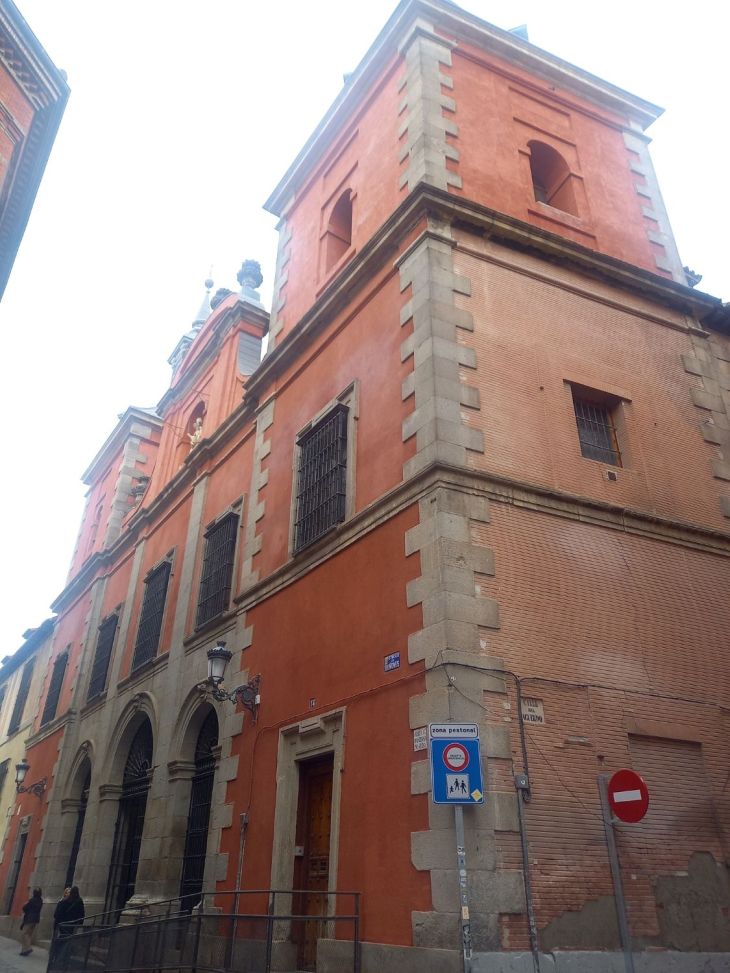
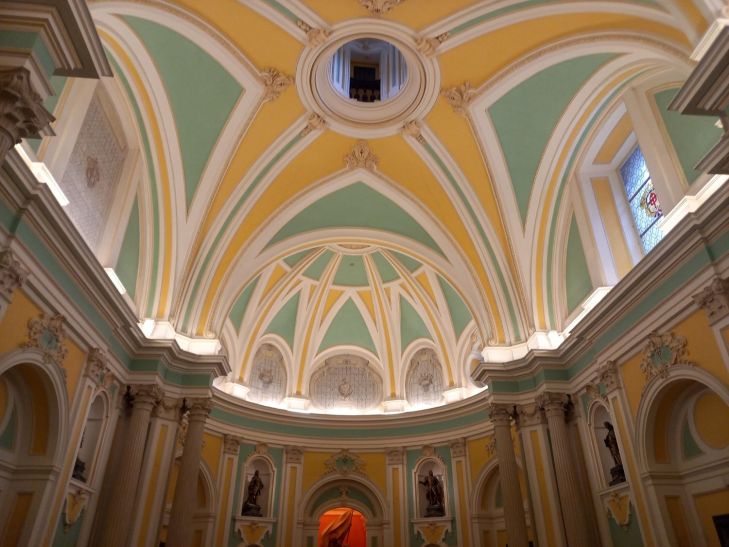
The Parrish Church of Santiago el Mayor most notable feature is a Greek cross layout, with a dome on pendentives in the center. The convent dates back to 1753, when the rooms such as the Knights’ Sacristy and the courtyard were built. In 1774, Carlos III commissioned Francesco Sabatini to construct a new building, which completed the urbanization of the block. At the beginning of the Spanish Civil War, the nuns were forced to abandon the convent when the building was seized and occupied by militias, causing significant damage. During the war, numerous works of art, relics, furniture, and other valuable historical objects were stolen, much of which was recovered after the war. In 1939, it was converted into a men’s prison for Republican prisoners until 1941, when the nuns recovered the entire convent.

At the end of a hall against a red background, see a huge image of Saint James the Apostle on horseback, holding a large banner. The Knights’ Sacristy, restored is located here. Although it’s called a “sacristy,” it isn’t a sacristy as such (i.e., the place where priests vest before saying Mass), but rather a ceremonial room where those who were to be knighted crusaders kept vigil. The colors decorating the walls are those of the Order: blue-green represents the laurels of the victors; yellow, the conquered land; and red, the blood of the martyrs. We arrive at a small courtyard, the so-called Patio de Moradillo, and there it is told how during the Spanish Civil War, the Convent was used as a checa (political prison) and that executions were carried out in this courtyard. The Capilla de las Niñas or girls’s chapel, so named because it was where boarding school girls used to attend Mass, is located. Above the altar, see a huge painting of the Virgin Mary, an Immaculate Conception by the painter Murillo behind the altar of the chapel to see the sarcophagus where the remains of Mother Mariana rest. We climb a staircase and arrive at the Capilla del Consuelo or Consolation Chapel, which leads to the Sala Capitular or Chapter House where the nuns received royalty and the aristocracy.
Initially, the Comendadoras were contemplative nuns of strict enclosure under the Rule of Saint Augustine. But today, they are semi-cloistered and dedicated to various tasks. There are three convents left in Spain: the one in Madrid runs an Early Childhood Education School, the one in Toledo makes sweets and lace, and the one in Granada runs a hostel. The Real Monasterio de Santiago el Mayor is located at Plaza de las Comendadoras ,10 get there on Metro San Bernardo ,lines 2 and 4, To see it you must have reservation on site or bycalling +34 91 548 18 42,
The official Fundacion Comendadoras on the convent church: http://fundacioncomendadoras.org/10iglesia.html
The Madrid tourist office on the convent of the Comendadoras of Santiago : https://www.esmadrid.com/en/tourist-information/convento-de-las-comendadoras-de-santiago
There you go folks, another dandy of my dear Madrid, never enough of it. This is in a seldom visited area but very much worth the detour, me think, Again, hope you enjoy this post on the Convento de las Comendadoras and Parroquia Santiago el Mayor of Madrid !!! as I.
And remember, happy travels, good health, and many cheers to all !!!

 Paris1972-Versailles2003