
One of the most emblematic monuments in the Comunidad of Madrid ,, this is the Convento Monasterio de San Antonio y San Juliàn, a wonderful architecturally and with a nice history of Spain, Therefore, let me tell you my take on the Convento Monasterio de San Antonio y San Juliàn of La Cabrera !!! Hope you enjoy it as I.

This is a wonderful spot that is to wonderful to found pictures in my cd rom vault to show to the world in my blog for you and me. The Convento Monasterio de San Antonio y San Juliàn is located at Carretera de Madrid towards Burgos (A1) at the village of La Cabrera, in the Comunidad de Madrid region, It is about 57 km from Madrid and about 2 km from the village of La Cabrera, that as said can be reach by the A1 highway. It is located in a wild area, at an altitude of 1,190 m, on the slopes of Cancho Gordo, the highest peak of the Sierra de La Cabrera with a height of 1,564 meters. It is an island-mountain on the southern slope of the Sierra de Guadarrama.
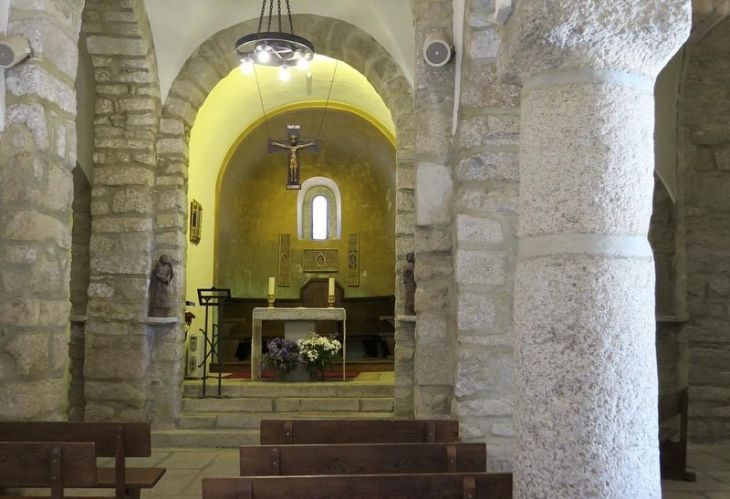
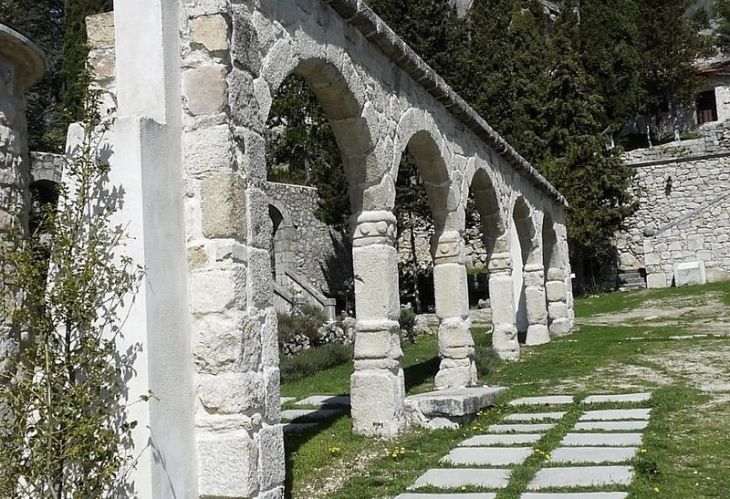
Despite its small size, it has a structure of some complexity, with five apses, three naves and a transept. Decorative nakedness is another characteristic of the temple, which is almost completely devoid of sculptural motifs, both on the outside and inside. We can only mention the presence of several shields on the west and south walls, alluding to the Franciscan order and the Duchy of Infantado, to which La Cabrera was attached. They were installed during the reforms carried out in the 15-16C. The preserved arcade of the cloister and the lower body of the tower, which is square and can be dated from the 15C, also correspond to these reforms. It is probable that the upper part of this is later, possibly from the 18C. Inside, the supporting elements of triumphal arches and entrance arches to the transept are cruciform pillars, while those extending the naves are four columns with cylindrical shafts and simple capitals that could belong to reforms or reconstructions already in the 15C.
A bit of history tell us that the exact date of its foundation is unknown. Although its Romanesque style dates back to the 11-12C, the appearance of a small necropolis nearby would reveal a Visigothic origin. Its first consecration was that of Saint Julian and, until the 14C, it was run by the Benedictine order. In 1404 it passed into the hands of the reformed Franciscans of Pedro de Villacreces, remaining under the patronage of Saint Anthony of Padua. The place was abandoned during the Napoleonic invasion. In 1812 the Franciscans were able to re-establish themselves, remaining until 1835, when they were exclaustrated as a consequence of the Mendizábal Confiscation (sep state and church). Later, it was bought by the descendants of the painter Francisco de Goya. In the 20C, the doctor Carlos Jiménez Díaz took over the property and proceeded to its rehabilitation and adaptation for residential use. After the passing of Jiménez Díaz , the place was abandoned and was subject to looting and plundering. Since 2004, it belongs to the Idente Missionaries, who, in addition to their religious function, promote the celebration of cultural and social activities. The convent has had various uses over the centuries. It was used as a hostel by historical figures such as the Marquis of Santillana and Cardinal Cisneros and even served as a prison for the clergy for a short period of time. Traditionally, it has been considered that the Monastery was promoted by King Alfonso VI in the 11C and occupied by the “Order of the Rule of Saint Benedict”.
Briefly, a convent indicates not only the building where the religious live, but also the community of religious people who live in the same house. While a monastery is a word that strictly refers to the place, usually outside the town, where monks live in community.
The official convent monastery : http://www.conventolacabrera.com/
The Comunidad de Madrid region tourist office on the convent monastery: https://www.comunidad.madrid/en/cultura/patrimonio-cultural/convento-monasterio-san-julian-san-antonio-cabrera
There you go folks, another dandy in my dear Spain, The choices are endless and beautiful architecture and history all over, we love it!. Again, hope you enjoy this post on the Convento Monasterio de San Antonio y San Juliàn of La Cabrera !!! as I.
And remember, happy travels, good health, and many cheers to all !!!

 Paris1972-Versailles2003