
I will talk about the some of the wines of Italy. I have tried several Italian wines over the years and in Italy, Americas , and even more in France. I was first introduce to Italians wines after meeting Michele Chiarlo in a wine tasting in Crown Wine and Liquors Miami Fl many years ago ,definitively in the 90’s I like to give a brief introduction of a deep subject , Therefore, here is my take on the wines of Italy !!! Hope you enjoy the post as I.
Bardolino is a town in the province of Verona, in Veneto, Italy. Bardolino is a dry wine from the Veneto region that has been awarded the DOC designation since 28 May 1968. There is, also, a Bardolino Superiore DOCG designation. The wine is primarily made from the Corvina, Rondinella, and Molinara grape varieties. The wines are generally light to medium-bodied. They are distinguished by their fruity aromas of cherries and berries, with a hint of spice. herTe are different types of Bardolino wine, including: Bardolino Classico: This is the traditional version of the wine. It is grown in the central region around Bardolino. It is distinguished by its freshness and liveliness. Bardolino Chiaretto: This is the rosé version of the wine. It is produced through a short maceration process. It is characterized by its delicate color and fruity notes. Bardolino Novello: This version is sold young, immediately after harvest. It is light, fresh, and ideal for immediate tasting. Enjoy after a short decanting period, at a temperature of 14 to 16 °C. In dry, dark, and well-ventilated rooms, it can be stored for up to 4 years. For a better taste experience, however, it is recommended to consume it within the first two years after bottling.
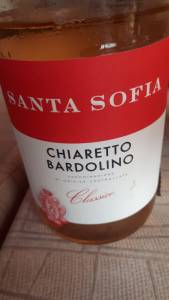
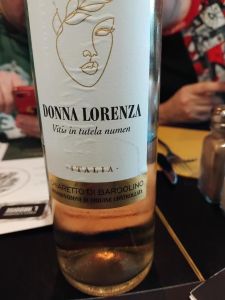
Some of my latest from Bardolino : Santa Sofia Bardolino DOC from vineyards of Corvina, Molinara, Rondinella, a Veronese Rosè of San Pietro in Cariano, Verona, Tana di Lupo Bardolino Classico from the region of Veneto. Hilly classic area on the eastern shores of Lake Garda. Villages of Bardolino, Lazise, Cavaion and Garda. Blend of Corvina (65%), Rondinella (25%) and mix of different red grapes (10%). Bardolino Donna Lorenza red with grapes Corvina, Rondinella, and Molinara from Verona.

Chianti is a red wine produced in the Chianti region of Tuscany, with a history dating back to the 13C, in strictly demarcated areas of the provinces of Florence, Siena, Arezzo, Pistoia, Pisa, and Prato. It now generally comprises two grape varieties: Sangiovese is largely dominant at over 80%; Merlot, Canaiolo, or other indigenous grape varieties may also complete the blend. There are two main types of Chianti, corresponding to two maturation methods: “Normal” Chianti, once sold in the famous flask, is designed to be drunk young. It may have a very slight sparkle that comes from its production process, called il governo, which consists of the addition of dried grape must after fermentation. Chianti Riserva must age for twelve months in oak barrels and three months in bottle before being sold. It is normally packaged in slightly conical Bordeaux-shaped bottles. Traditionally, it was easily recognizable thanks to its typical bottle with an elongated neck and a rounded base surrounded by a wicker basket: the fiasco. Since August 1, 2009, ten wines from the Chianti geographical area have been protected by the Denominazione di origine protetta (DOP) quality label. Chianti followed or not by Colli Fiorentini, Chianti followed or not by Colli Senesi, Chianti followed or not by Montalbano, Chianti followed or not by Montespertoli, Chianti followed or not by Colli Aretini Chianti followed or not by Rufina, Chianti followed or not by Colline Pisane, Chianti Classico, Vino Santo del Chianti, and Vino Santo del Chianti Classico
My latest from Chianti, DOCG Chianti La Piuma 100% Sangiovese.

Montepulciano d’Abruzzo is a vineyard in the Abruzzo region that has been awarded a DOC designation since May 24, 1968. Production area includes the provinces of Chieti, L’Aquila, Pescara, and Teramo. The appellations of the production area are: Montepulciano d’Abruzzo cerasuolo, Montepulciano d’Abruzzo rosso, Montepulciano d’Abruzzo rosso riserva, and Montepulciano d’Abruzzo Colline Teramane. Montepulciano is both a grape variety and the name of a village. Montepulciano d’Abruzzo is the wine produced from the Montepulciano grape variety. Montepulciano d’Abruzzo DOC are red wines made from the Montepulciano grape variety in the Abruzzo region of east-central Italy. It alone accounts for over 80% of the total wine denomination produced in Abruzzo and is among the top three DOC wines produced in Italy.
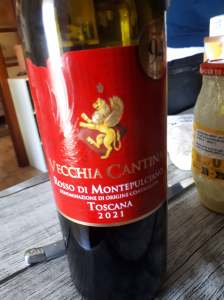
Some of my latest from Montepulciano d’Abruzzo, Gran SassoTerra Vera Edizione Limitada Montepulciano d’Abruzzo Colline Teramane with grapes of Montepulciano from the region of Abruzzo Vecchia Cantina di Montepulciano of the region of Tuscany It has a medium intensity ruby red with violet shades. Bouquet ; open, lingering, with good notes of red berry fruits, morello cherry and redcurrant, which enhances its fineness. In the mouth is full, with good vanilla notes, pleasant balance between tannin and acidity. Ideal service temperature: 16-18° C.

A vast coastal area that occupies parts of Tuscany and upper Lazio, starting south of the provinces of Pisa and Livorno and extending beyond Tarquinia, passing through Rosignano Marittimo, Piombino, Punta Ala, the mouth of the Ombrone River, the Uccellina Mountains, the Orbetello Lagoon, Lake Burano, the Tolfa Mountains, and Chiarone. This is the Maremma, Rocca di Montemassi is located at the foot of the ancient village of Montemassi in Southern Tuscany, between the Mediterranean coast and the Metalliferous Hills. Le Focaie, primarily Sangiovese 90% with a small percentage 10% of international grape varieties, takes its name from the “focaie stones” found throughout the Maremma territory. It captivates with its spicy notes and a soft, very pleasant sip.
My latest from Montermassi, Domaine Rocca di Montermassi Le Focaie red from Tuscany, with grapes Cabernet Sauvignon, Merlot, Syrah but also Sangiovese as in this bottle,

Just for the memories and credit and the taste of Italian wines here is a brief story, I met Michele in 1997 at Crown Wines & Liquors of Coral Gables Fl on a wine tasting event. Since 1956, Michele Chiarlo has been vinifying the essence of Piedmont, loving and developing the most incredible wine region in the world. They cultivate 110 hectares of vineyards between the Langhe, Monferrato, and Gavi areas, within them the finest crus while fully respecting the ecological criteria, terroir, and their expression. Right in the 1990’s Michele’s two sons join the winery: Stefano, to take care of the agricultural and oenological side, and Alberto in sales and marketing In 1995 the Barbera finally has its temple. Michele Chiarlo acquires the Tenuta La Court, twenty extraordinary hectares in Castelnuovo Calcea, historic heart of the designation. Stefano and Alberto Chiarlo continue to work, following the tradition of a family business with an international outlook. Attention to the details, maniacal care of the vineyards, vinification while respecting the terroirs and the vines, artisanship of the processes. Characteristics which make the winery in Calamandrana one of the most important oenological realities in Piedmont, firmly believing in the exclusivity and continued investment in indigenous grape varieties. Michele Chiarlo at Strada Nizza-Canelli, 14042 Calamandrana Asti – Piedmont – Italy The official Michele Chiarlo : https://www.michelechiarlo.it/en/
The Italian wines on its regions: https://italianwine.guide/regions-en-gb/
The consortium on Italian wines: https://www.consorzioitaliadelvino.it/en/management/
There you go folks, enjoy the wonderful world of Italian wines, we do drink them. A world of their own, Again hope you enjoy the post on the wines of Italy !!! as I.
And remember, happy travels, good health, and many cheers to all !!!

 Paris1972-Versailles2003