
We were back to my dear Spain again !! love it !! We came by car of course and took time to see some new towns with my sons and our dog Rex ! I rented a small house in a off the beaten path country town that was just perfect ! I like to continue the saga of our new road warrior experiences even if now with less in our family,This post is on my latest road warrior tour of wonderful sublime Spain. Therefore, let me tell you about the Castillo (castle) of Arévalo !!! Hope you enjoy the post as I.
The town of Arévalo is in the province of Avila, in the Autonomous Community of Castilla y Léon , in the kingdom of Spain, Only 73 km from our rental house in Velliza and 126 km from Madrid, We were going to Madrid with book reservations and had extra time in the morning so I took my road warrior mode on and came in off the A6 highway to see this wonderful town passed many times and finally in, This is a new town and find in my world map, Spain is huge of beautiful towns, working on it still….
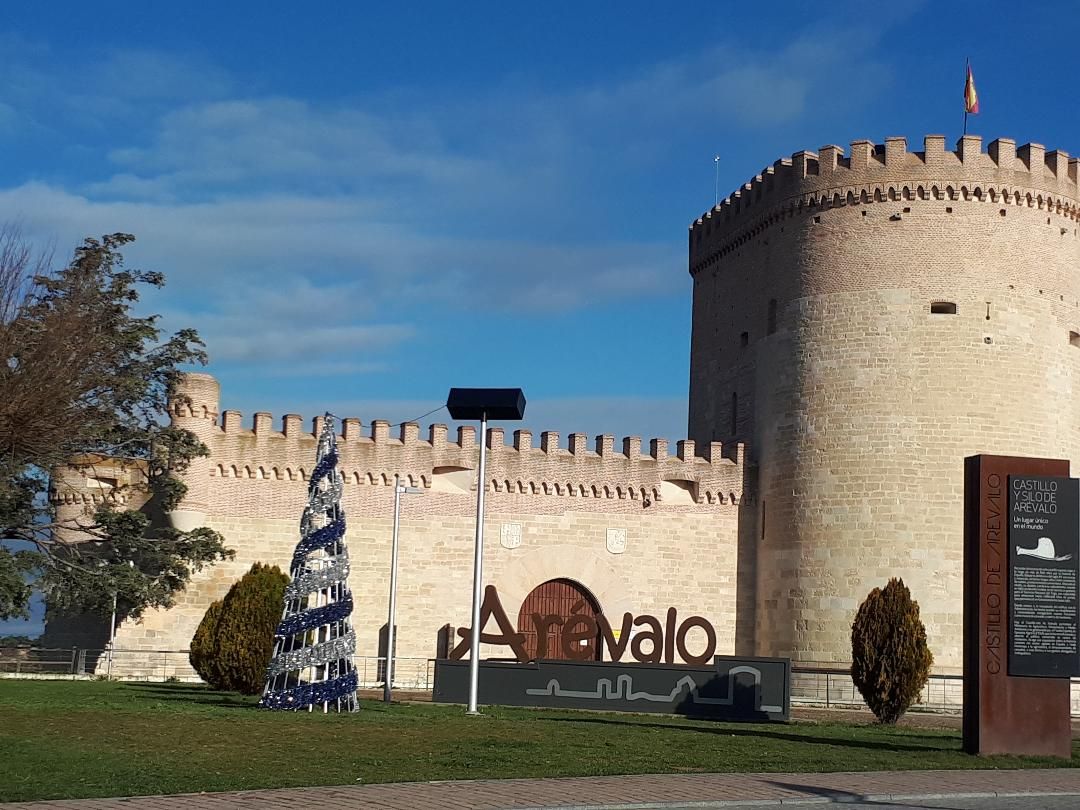
The Castillo of Arévalo (castle) occupies the most extreme part of the rocky hill formed by the confluence of the Adaja and Arevalillo rivers. In its origin, the original fortification was linked to the wall. The Torre del Homenaje or tribute tower was built on a Mudejar -style, The current castle dates from the second half of the 15C, although it subsequently suffered important reforms at the beginning of the 16C, with these changes it went from a square plant to the pentagonal plant that characterizes it. During the 19C it suffered abandonment phases and was also used as a sacred field and stone quarry finally the city gave the castle to the Ministry of Agriculture, which undertook different reforms and restoration works. It now welcomes a cereal museum, and is open for visit during the weekends and national holidays, making guided tours,

The castle was ordered to build in the mid -15C by Don Álvaro de Zúñiga, and at his death he passed to the Catholic Monarchs ((Isabel and Fernando). Subsequently, it was converted into prison until the 17C, and during the War of Independence its defenses were eliminated. In the 19C with the War of Independence, it gradually ruined, taking advantage of his enclosure as a cemetery until the 20C. Its main function was to serve as a prison for renowned characters. In it was locked Mrs. Blanca de Borbón by her husband, King Pedro I the cruel. Subsequently, in 1592, Felipe IV maintained prisoners between his walls to the Prince of Orange, Mr. Guillermo de Nassau, and his custodian, Captain Don Diego Osorio. The castle was built in stone and brick are mixed with singular beauty. In its construction some Italian influence is noticed. Its plant is pentagonal and has a large tower of tribute. The walls that surrounded the population split from the fortress. On the canvases of the castle there is no vain, which confirms its defensive character. Circular cubes stand out very little from Adarve, giving rise to two heights, that of the Torre del Homenaje and the Patio de Armas. The primitive work was Mudejar and was made of stone. it was later covered by another, also of stone, which gave it the rounded shape. Only in this spectacular tower a geminated window and several mailbox troneras opens, thus marking its warrior importance.
The city of Arévalo is one of the cities of Castile with the greatest number of Mudejar monuments. The Muralla or Wall only appreciable in part, due to its deterioration you can see the door called Arco de Alcocer, popularly called Arco de la Carcél for having used as a local jail in certain periods, and which was the main entrance of the wall, currently hosting the city’s tourism office. The medieval wall, of which some remains remain today, was built between 1157 and 1195. With the passage of time its defensive role evolves to mere containment. At the end of the 19C and the beginning of the 20C, they were true quarries for obtaining construction materials, which caused the loss of a large part of their canvases. The original wall consisted of 1630 meters perimeter and 20 hectares of surface. It also had five doors of which only Alcocer is preserved, constituted by a tower with several arches pointed out as a tunnel. Only some sections are maintained between the Caserío of the city and the Rincón del Diablo one of the remains that are still standing from the west section of the south canvas, which went from the Puerta de San Juan, now gone, to the slopes of the river Arevalillo There are other remains barely visible at the height of Asador La Posada and behind it. The ring road between walls ran through the current Calle Casablanca and Calle Entrecastillos.
The City of Arévalo on its heritage : https://arevalo.es/turismo/que-ver-y-hacer/
The Castilla y Léon regional tourist office on Arévalo : https://www.turismocastillayleon.com/en/heritage-culture/arevalo
There you go folks , another wonderful nostalgic, sentimental trip to my dear Spain, Do not know when we will be back, we sure will have this trip in our hearts forever, Again, hope you enjoy this post on the castillo (castle) of Arévalo !!! as I
And remember, happy travels, good health, and many cheers to all !!!

 Paris1972-Versailles2003
💙
LikeLiked by 2 people