
We were back to my dear Spain again !! love it !! We came by car of course and took time to see new areas and old repeat with some of them as introduction to my sons and our dog Rex ! I rented a small house in a off the beaten path country town that was just perfect ! I like to continue the saga of our new road warrior experiences even if now with less in our family, This post is on my latest road warrior tour of wonderful sublime Spain. Therefore, let me tell you about the Church of the Holy Sepulcher of Toro !!! Hope you enjoy the post as I.
The town of Toro is in the province of Zamora, Autonomous Community of Castilla y León in the kingdom of Spain, It is located 46 km from our rental house in Velliza, 62 km from Valladolid , 79 km from Salamanca, 148 km from Avila and 221 km from Madrid. The town stands at 722 meters above sea level. The town is crossed by the roads we took, the Autovia del Duero (A-11) that links Zamora provincial capital with Tordesillas. And the national road N-122 the alternative to the above highway, and more local.
The Church del Santo Sepulcro (of the Holy Sepulcher) was the headquarters of the General Vicar of the Order of the Holy Sepulcher of Jerusalem until the 15C that passes to the order of Malta. Inside, the figure of the Baroque Christ of the Expiration and several of the main steps of Holy Week stands out. It is located in the Plaza Mayor just in front of the city/town hall Plaza Mayor just in front of the city/town hall The Church del Santo Sepulcro,the church bears the name of the Church of the Holy Sepulcher since it depended on the origin of the order of Saint-Jean de Jerusalem. Open to the public only in 2006, the church met with some success with tourists In 2016 the presence of the large exhibition “Las Edades del Hombre”, benefits the church which is integrated into the circuit. In addition, it is also part of the ticket combined with the collegiate church and other small churches in the city, a boon for lovers of sacred art.
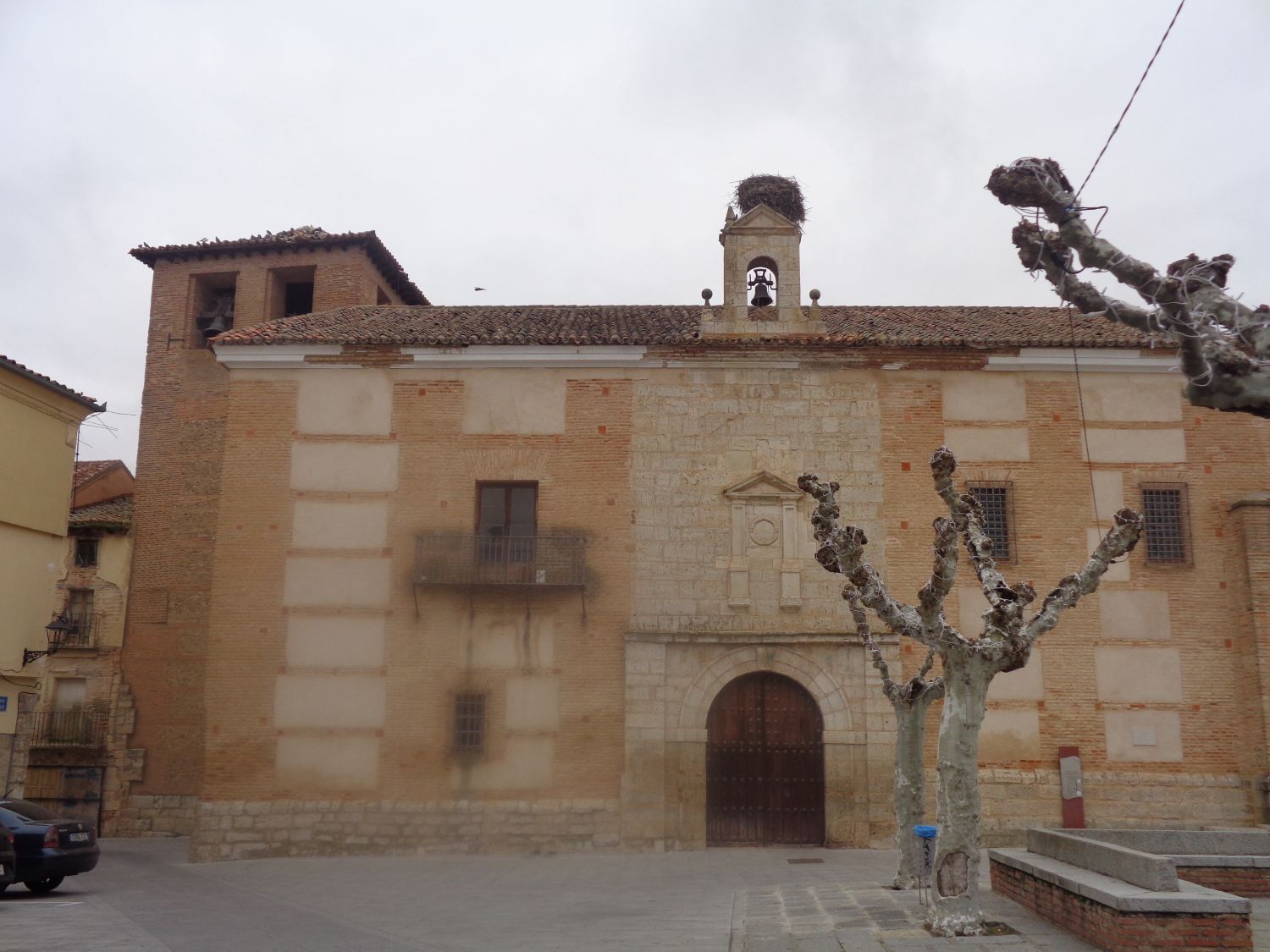
The southern facade of the 17C is the only thing that passersby notice when they walk through the square. There is here a tower that seems to attest to an origin prior to the construction of the 13C, but most of the building belongs to the Romanesque of brick or Mudejar Castellano Léon of the 13C, although with enough reforms . Initially belonged to a monastery of the Order of the Holy Sepulcher, which was the parent company of the sepulchrist establishments of León, Galicia, Castilla, Navarra and Portugal since the 12C. Although in 1498 ,it was donated to the hospital of San Juan de Jerusalem. On the exterior , unfortunately, the aforementioned apesides of the 13C cannot be seen from the outside of the square. In the 17C, the sacristy is added and the southern facade is restructured. The only remarkable thing is a sector of the imafronte (Facade that rises at the foot of a church or a cathedral, opposite to the head), that is in sight since part is also covered.
The interior although it is first cited on the early date of 1128, it must have been rebuilt since its structure was based on that of others of the 13C: Basilical plant of three naves separated by fuzzy arches pointed out of triple archivolta, which above they would support a wooden roof. Such naves end in a tripartite head of three semi -circular plant decorated by brick archery stripes with the indoor interior, separated by a frieze in skiing, which also runs the upper part. In the sphere room vault of the apse, mural paintings belonging to the linear Gothic were discovered in 2001. It is a Christ in Majesty within the mystical mandorla and surrounded by the four living that the Apocalypse of St. John recounts as the time of the parousia or coming in Glory of Jesus. Special beauty result in lighting openings that were created in the head of the header, by means of a rosette and four half -point windows with a wide spill. In the 16C, central form arches are suppressed to link their pillars with large granite arches in order to increase the sensation of space. Among the works of imagery, here that are preserved in Holy Week steps. It is necessary to highlight an 18C Christ, and a sculpture of the Risen Christ also of the same century, For their part, remains figured and polychrome from the armor of the 12-14C, The naves are covered with a pair and knuckle armors made in the second half of the 16C.
The Romanesque in Zamora province so the Church Santo Sepulcro: https://www.romanicozamora.es/en/monumentos/ver/church-of-santo-sepulcro/87
The Toro sacre on the heritage as the Church Santo Sepulcro: https://torosacro.com/conjunto-monumental/santo-sepulcro/
The Toro tourist office on its heritage: https://www.turismotoro.com/index.php/es/toro-monumental
The Castilla y Léon regional tourist office on Toro: https://www.turismocastillayleon.com/en/heritage-culture/toro
There you go folks , another wonderful nostalgic, sentimental trip to my dear Spain, Do not know when we will be back, we sure will have this trip in our hearts forever, Again, hope you enjoy this post on the Church of the Holy Sepulcher of Toro !!! as I
And remember, happy travels, good health, and many cheers to all !!!

 Paris1972-Versailles2003