
We were back to my dear Spain again !! love it !! We came by car of course and took time to see new areas and old repeat with some of them as introduction to my sons and our dog Rex ! I rented a small house in a off the beaten path country town that was just perfect ! I like to continue the saga of our new road warrior experiences even if now with less in our family, This post is on my latest road warrior tour of wonderful sublime Spain. Therefore, let me tell you about curiosities of Salamanca, part II !!! Hope you enjoy the post as I.
The City of Salamanca is capital of the province of Salamanca located in the Autonomous Community of Castilla y León, and in the kingdom of Spain. In 1988, the Old City was declared a World Heritage for UNESCO, The City is located 109 km from Ávila, 121 km from Valladolid, 123 km from Portugal and 214 km from Madrid.
The calle de Zamora was for centuries the main entrance to Salamanca. There they built their stately houses and mayorazgos many noble Salamanca lineages. Today, very renovated, barely retains vestiges of what it was, but maintains that distinguished air that seems consubstantial to its innate transit nature . The street that honors the neighboring province owes its name to the door of the old wall and for that exit was the road that led to Zamoran lands, thus lending a name to this central and significant street. A curiosity of this street would be that its triumph arches owes to the visit of Alfonso XIII in 1904, as well as Calle Toro and the Plaza de los Dominicos. In this street, apart from buildings of interest, just one hundred years ago, in 1919 was one of the first stores of all to 65 cents of peseta (1 peseta are € 0.006) one of predecessors of what we currently know as ‘Chinos’ small grocery stores usually run by Chinese or oriental immigrants.

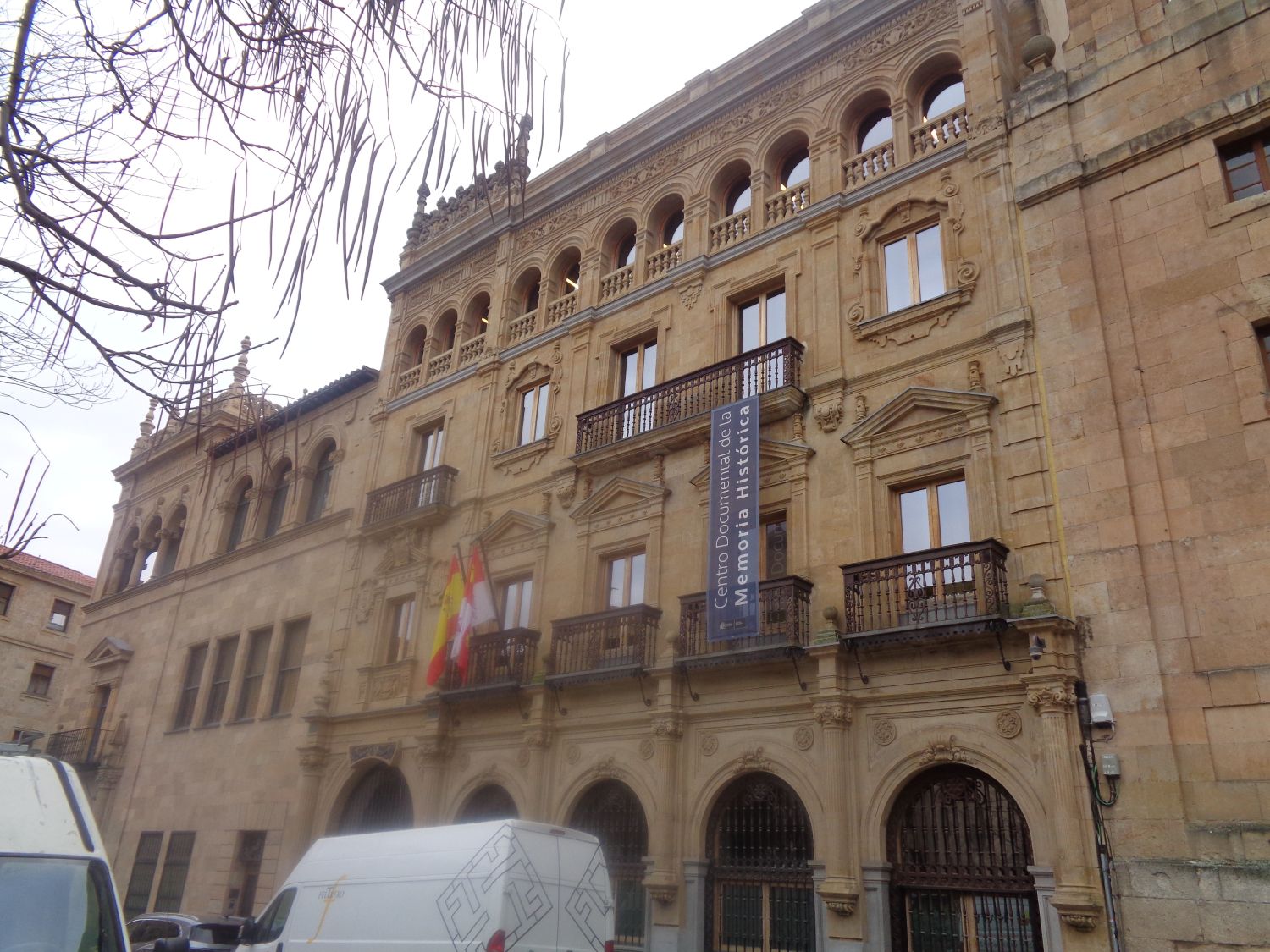
The Centro Documental de la Memoria Histórica, or CDMH houses a wealth of diverse documentation covering the Second Republic, the Spanish Civil War, the Franco dictatorship, the Republican exile, the deportation of Spaniards to concentration camps and the transition to democracy. These documentary collections include an important archive and an outstanding specialized library and newspaper library. This documentation can be consulted by researchers and the general public. In addition to its archival and library work, the CDMH carries out an outstanding task of cultural dissemination through the organization of activities, exhibitions, the development of specific content for this website and social networks and the implementation of educational activities. Created in June 2007, the CDMH has two headquarters, located respectively on Calle Gibraltar ,and in Plaza de los Bandos(pic),
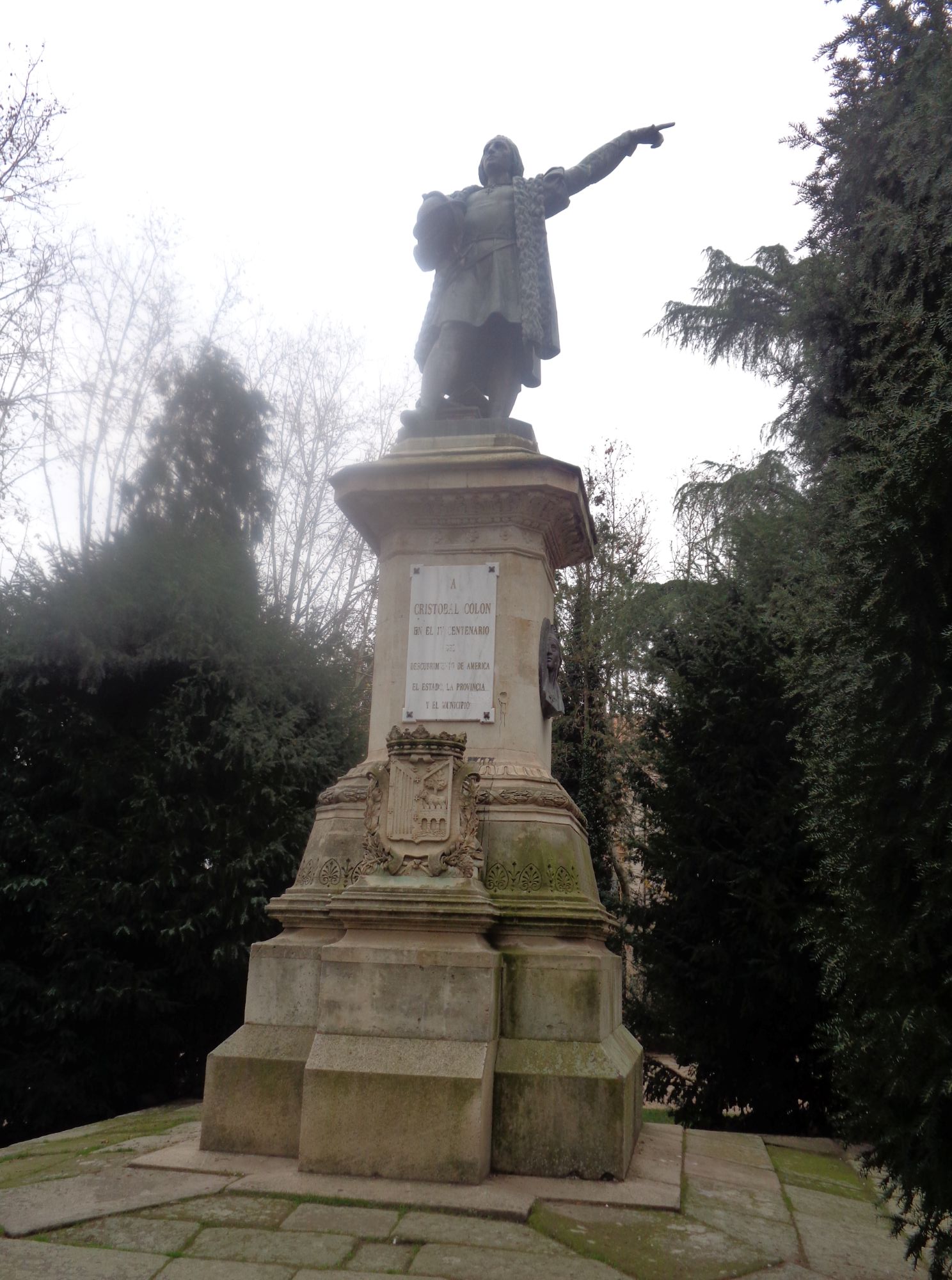
The plaza de Colón was formerly known as Plaza de San Adrián because the square was home to the now-disappeared Church of San Adrián. It acquired its current name in 1893 when, a year late, the fourth centenary of the discovery of America was commemorated by erecting a monument to Christopher Columbus.(Cristobal Colon), The canapé-type benches that surround the square come from the Plaza Mayor. When the gardens were removed from the latter, the benches were distributed between the Plaza de Colón, Plaza de los Bandos and Plaza de La Libertad. In the center of the square is the Monument to Columbus, erected in 1893. The following historic buildings are located around the square: La Salina Palace, a Renaissance palace, Orellana Palace, a classicist palace from the last third of the 16C, and the Anaya Tower, a stately home with a truncated tower. The Clavero Tower, a 15C manor house with a military appearance. The former convent of the Discalced Trinitarians, which currently houses the Courts of Salamanca and the Church of San Pablo, the former church of the Trinitarian convent built in the 17C, now a parish church.
The Monument to the Turroneras de La Alberca is a tribute to the nougat makers and is located next to the central market (Abastos) was opened in September 2017 and pays homage to the nougat makers of La Alberca. represents a 19C manufacturer sitting at her work table and with the utensils she used to cut this sweet. It is a bronze molten sculpture with dimensions of approximately 1.60 cm high and 1.40 cm wide, and a weight of 600 kilos. Still produced by hand and for more than two centuries, it is common to see the sale of La Alberca nougat in part of the arcades of the Plaza Mayor, at Christmas time. La Alberca, is the last redoubt that remains in Spain, with the exception of the areas of Jijona and Alicante, which make the nougat in a totally handmade way.

The Plaza de Toros de Salamanca, aka La Glorieta ,currently has a capacity of 11,800 persons. The construction of this bullring began on May 30, 1892 and ended with its inauguration on September 11, 1893, The central circumference has a measure of 54 meters and the outer circle of 88 meters, The plaza de Toros has not only has witnessed the celebration of bullfights over the years, but has served for multiple uses, The main bullfighting celebrations held are in September, coinciding with the festivities of Salamanca of the Virgen de la Vega the Day 8, and on the 21st of that month that corresponds to the feast of San Mateo, together with June 12, which is the day of San Juan de Sahagún, patron of the city.

The City of Salamanca on its history : https://aytosalamanca.es/w/historia
The Salamanca tourist office on its heritage: https://salamanca.es/en/essential-salamanca/culture-and-cultural-heritage/monuments
The Castilla y Leon regional tourist office on Salamanca :https://www.turismocastillayleon.com/en/heritage-culture/salamanca
The Unesco world heritage site on old town Salamanca: https://whc.unesco.org/en/list/381/
There you go folks , another wonderful nostalgic, sentimental trip to my dear Spain, Do not know when we will be back, we sure will have this trip in our hearts forever, Again, hope you enjoy this post on curiosities of Salamanca, part II !!! as I
And remember, happy travels, good health, and many cheers to all !!!

 Paris1972-Versailles2003