
Again, looking at my blog found several older post that needs update and doing so with new text and links for you and me, This is my dear Madrid with so much to offer seldom seen by visitors. Even if Spain is the second most visited country in the world according to the official WTO-UN. I have another post on the basilica but this one is more on the history and architecture for you and me. Therefore, this is my new take on the Basilica minor San Francisco El Grande of Madrid, part II !!! Hope you enjoy the post as I.
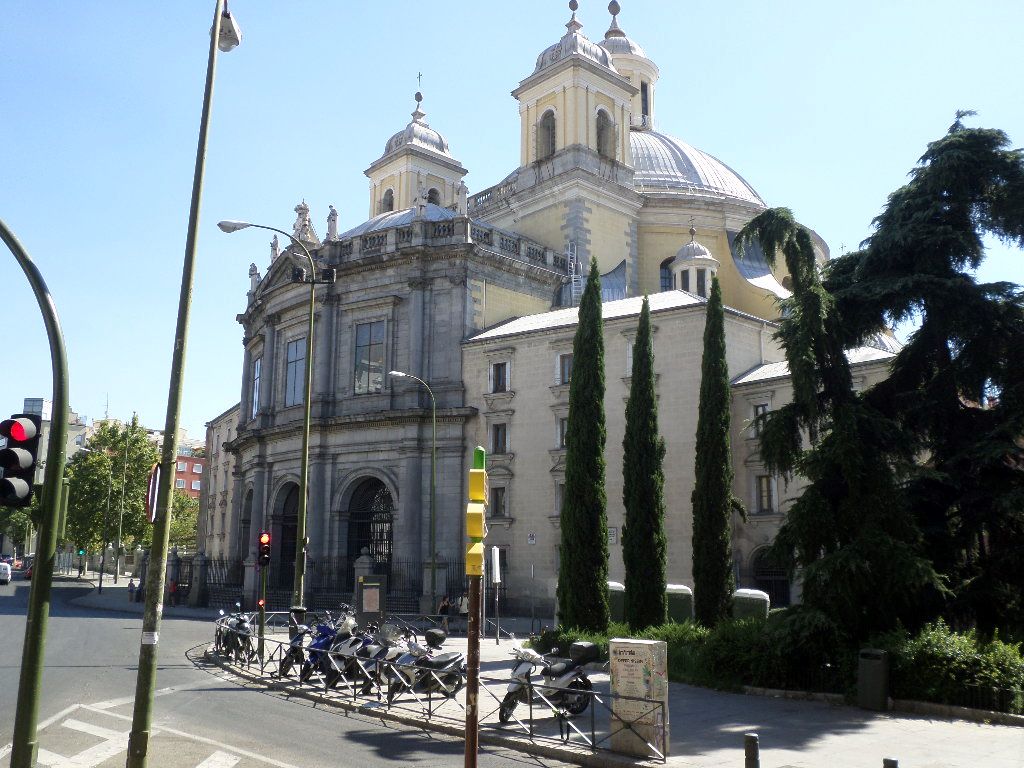
The Basilica Minor of San Francisco El Grande is in the district of Palacio, within the historic center of Madrid. It presides over the western face of Plaza San Francisco , set by the intersection of Calle Bailen and the Carrera de San Francisco street just walking right from the Palacio Real. It is part of the Franciscan convent of Jesús y María, founded at the beginning of the 13C, on a now gone hermitage dedicated to Saint Mary. The current Basilica was built in neoclassical style in the second half of the 18C. The Basilica stands out for its dome, considered as the third largest diameter circular plant in Christendom. For its sumptuous interior decoration, made in eclectic style at the end of the 19C, and for its art gallery, representative of the Spanish painting from the 17C to 19C, with paintings by Zurbarán and Goya. Its management corresponds to the pious work of the Holy Places of Jerusalem, an autonomous body dependent on the Ministry of Foreign Affairs and Cooperation.

The Basilica Minor San Francisco el Grande is a central and circular plant, with vestibule and apse. The roof is solved by a large dome, guarded by six small domes, which surround the base of the basilica by the north and the south. The dome of San Francisco el Grande is 33 meters in diameter and 58 meters high (72 meters from the ground level). As far as the circular plant domes are concerned, it is the third largest diameter of Christendom. It is made of solid brick, made on a single sheet. At its start, the leaf has a thickness of three meters, which goes down to the coronation, where the thickness is lower than the meter. The dome is crowned by a circular lantern, with spire and wrought iron cross over the arrow. The main façade is east-facing, and presents two bodies. At the bottom are three arches of half a point, fastened by Doric pilasters. The Ionic order dominates the second body, consisting of three roofed windows. The façade is dominated by two towers, one at each end, slightly recessed. They are covered with wavy spires, topped with vanes. In its vanes, 19 bells are lodged, eight of them in the South Tower and the remaining eleven in the North Tower. The bell towers are framed with paired pilasters. The dome and its lantern protrude between the two towers, dominating the whole.
The interior of the Basilica Minor San Francisco el Grande most notable parts of the hall are the seven doors that allow entrance to the enclosure, which were carved in walnut wood in the 19C. The interior roundabout is paved with marbles, as well as its plinths, sumptuously decorated, its main artistic values are concentrated in the mural paintings of the cupola, the result of the renovation and refurbishment works, in the last third of the 19C. The main chapel is installed in the apse. Until the reform of the late 19C, it was presided by a canvas depicting the appearance of Jesus Christ and the Virgin Mary to St. Francis of Assisi. The six secondary chapels are distributed symmetrically, three on the northern side of the roundabout and three in the Southern. They are separated from the large circular space by means of pillars, which are supported by different half-point arches, which allow access. The chorus is installed in the upper part of the lobby. It was ornamented with the Gothic ashlars of the Cartuja de Santa María de El Paular, carved in walnut wood. The Basilica Minor San Francisco El Grande house a museum formed by 51 paintings, among other artistic pieces. The most valuable pictorial works correspond to the Spanish and Italian Baroque. Other rooms are the Ante-Sacristy and the Sacristy.
A bit of history I like tell us that the place was previously occupied by a convent-Franciscan hermitage, which, according to the legend, was founded by Saint Francis of Assisi in 1217. When king Felipe II converted Madrid into the capital of the kingdom, in 1561, the convent was gaining in wealth and importance and came to receive custody of the holy places conquered by the Crusaders, through a protective Junta of the pious work of Jerusalem, and the curated General of the Indies. In 1760, the Franciscans demolished the primitive building to built, on its plot, a larger temple which the works had to be suspended in 1768, due to the technical complications , the cupola, finally was done in 1770. The Basilica as a whole was finally completed in 1784. Eventually, it was converted into a hospital, according to decree of 1812. In the year 1836, the Franciscans were expelled and the Basilica was in the hands of the Spanish State, through the Royal Heritage Organism (Patrimonio Real). In 1838, it served as headquarters to an infantry barracks, while recovering the religious cult. In 1869 the idea of the national pantheon was resumed. During the next five years, it housed the mortal remains of different personalities of Spanish history, including those of Calderón de la Barca, Alonso de Ercilla, Garcilaso de la Vega, Francisco de Quevedo, Ventura Rodríguez, Juan de Villanueva and Gonzalo Fernández de Córdoba (The Great captain). They were deposited in a chapel and returned in 1874 to their respective places of origin. The rehabilitation period was used to decorate its interior, in a process that extended from 1880 to 1889 and in which different Spanish artists specialized in mural paintings and decorative arts participated. In 1926, King Alfonso XIII returned the temple to the Franciscans. On June 30, 1962 was declared a Minor Basilica by Pope John XXIII and on November 8, 1962 it was under the patronage of Our Lady of the Angels, after a new consecration. In November 2001, after decades of work, the church reopened to the public.
Around the Basilica are some interesting buildingns. One of the most important is the Capilla del Cristo de los Dolores or Chapel of the Christ of Sorrows for the venerable Third Order of San Francisco, located in an adjoining building, next to the northern facade of the Basilica. It was built between 1662 and 1668. In the year 2007, it was inaugurated the Dalieda of San Francisco, which extends to the south of the Basilica, where, in the Middle Ages, was located the cloister of the primitive convent on which the temple rises. To the west of the building, extends towards the Almudena Cathedral , the next door parque de La Cornisa, so called by its location to the edge of the hollow that forms the valley of the Manzanares river.
The Madrid tourist office on the Basilica Minor San Francisco el Grande : https://www.esmadrid.com/en/tourist-information/san-francisco-el-grande
The Cultural area of the City of Madrid monumental Madrid on the Basilica : http://monumentamadrid.es/AM_Edificios4/AM_Edificios4_WEB/index.htm#ingra:inmana.25454
There you go folks , one of the nicest off the beaten path sites in Madrid, even if in an area very much frequented near the Royal Palace and the Almudena Cathedral. This one is worth the detour, me think, Again,hope you enjoy the post on the Basilica Minor San Francisco el Grande of Madrid, part II as I.
And remember, happy travels, good health, and many cheers to all !!!

 Paris1972-Versailles2003