
And continuing my wonderful tour of updating older memorable posts in my blog, i come to Toledo. This is the world city of old and new, we came here often too as family just between Toledo and Madrid until recently the last one passed away. Looking forward to be back and ride my road warrior thrills on these wonderful spots and remember the good old times. Let me tell you about the Convento de San Pedro el Martir of Toledo !!! Hope you enjoy the post as I.
I come to you for a world historical city ,very popular and many times visited by me and many over the years. This is known to all me think. However, Toledo has in such a small space treasure throves of jewels to be seen. Time is still here ,and me think must go to the best known touristic wise. There are so many wonderful places to see here, and written briefly on many already. However, I feel need to tell you a bit more on this church in my dear Castilla La Mancha of Spain.
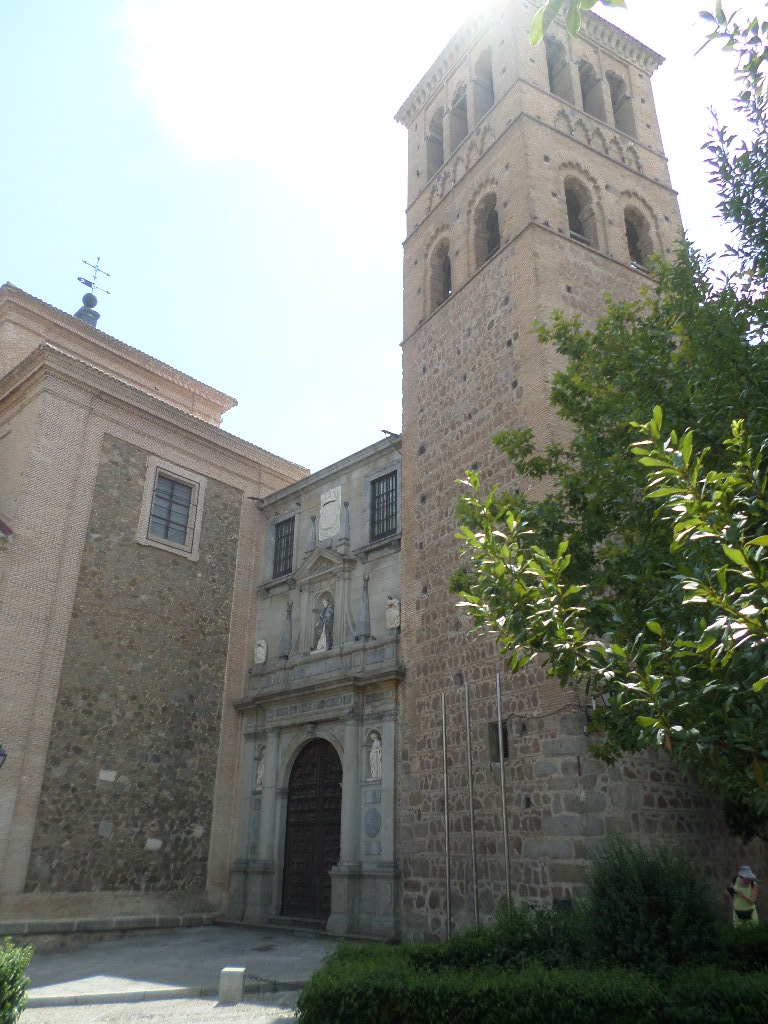
The Convent of San Pedro Martir, through its successive extensions and modifications, became one of the richest and most important convents of the city. The convent, large, is organized around three courtyards: the closest to the entrance is called Real or Royal; The smallest is called Silencio or silence/quiet, and the Naranjos or Orangery or Procesiones or processions is located on the side of the epistle of the Church. The cloister called the Silence is the oldest of all and possibly corresponds to a civil construction that, later, was included in the convent ensemble. It consists of three floors. The second floor is made up of lowered arches resting on columns very similar to the lower ones. The cloister of the silence contrasts with the Real, of much larger size, which began to be built with traces of Covarrubias, in 1541, by his disciple Hernán González de Lara. It consists of three floors entirely built in stone. The low floor is composed of half-point arches resting on columns. The new church and the sacristy. It began to be built in 1587 and consists of two spaces: the largest, rectangular, is the one that really serves as a sacristy, and another, square, houses a small Chapel. The main space is covered with a flat Cistercian vault, bands and with eyelids. The most direct access from the Church to the sacristy is made by a door located at one end of the main side. There is the Chapel of Santa Inés, whose architecture is Gothic, with vault of edges, which contains several interesting graves. The works of the current church began in 1605. As a curiosity, in this monastery, was a member, the Dominican friar Juan Bautista Maíno in 1613. It is a renowned painter whose works include the “Adoration of the Shepherds ” of the Museo del Prado in Madrid. Since 1991 the building serves as university headquarters of the Faculty of Juridical and Social Sciences of Toledo, belonging to the University of Castilla-La Mancha.
The Castilla La Mancha autonomous community tourist office on the convent of San Pedro: http://en.www.turismocastillalamancha.es/patrimonio/convento-de-san-pedro-martir-17164/
The Heritage site of Castilla La Mancha region on the convent: https://cultura.castillalamancha.es/patrimonio/catalogo-patrimonio-cultural/convento-de-san-pedro-martir-de-toledo
The wonderful monuments in the city of Toledo, are plenty more to browse while in town. I have several posts on the city in my blog for more information on visiting, no need to tell you further, is a must. The choices are endless with beautiful architecture and a huge amount of history of Toledo, Spain, and Europe. Again, hope you enjoy this post on the Convento de San Pedro el Martir of Toledo !!! as I.
And remember, happy travels, good health, and many cheers to all !!!

 Paris1972-Versailles2003