
I have found older paper pictures that should be in my blog even if quality is not as good, This is a work of love and nostalgia of times and places that will never be back from a beautiful city of Havana, now mostly in ruins, This is my native capital City, the city where I spent a great part of my very early life until 10 years old, Luckily was able to visit it in 1984, 1998, and 2012 , This is Havana or La Habana or the full name San Cristobal de La Habana, the capital of the Republic of Cuba. This is my Habana and would like to share these new old pictures with the world; do see my other posts on it, Therefore, here is my take on a train, squares and a hotel of Havana !! Hope you enjoy the post as I.
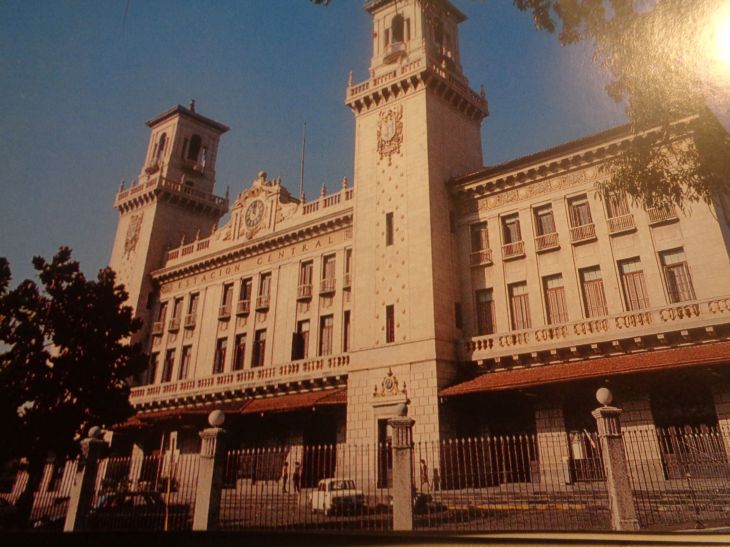
The Estacion Central de Ferrocarriles of Havana is the main railway terminal in Havana, and all of Cuba. The eclectic -style building has four floors, two high towers that are represented with the shields of Cuba and Havana, respectively, The previous train station at Villanueva, the first of Havana, had exceeded its capacity for the year 1910,and on November 30, 1912, the new central station was inaugurated on the Arsenal plot. It was built at the intersection of Calle Arsenal and Calle Egido . In front it has a paved square of cobblestones and closed by an iron and cement fence. With a peculiar architectural structure, sober and stylized lines, the building copy elements of the Spanish Renaissance and consists of four floors topped on both sides by two towers that rise 38 meters above the street level, built of reinforced steel and concrete and adorned with terracotta and tiles. On the ground floor is the waiting hall, decorated with marble coated columns. The complex extends with its elevated peculiar throughout the entire Ensenada de Atarés, one of the three channels of Havana Bay. The highs of Havana are of vital importance for the operations of the passenger trains that arrive or start from the central station. The restoration of the Central Station of Havana is part of a general modernization of a decrepit network of railroads in the country and was re-inauguration by December 2022. The first section of railroad in Cuba was of 27.2 km, lying between the towns of Havana and Bejucal, opened on November 19, 1837, becoming the pioneer of the Latin American world, pre-dating in almost eleven years to the first Barcelona -Matará line of Spain !
The Fuente de la India or fountain of the Indian or noble Havana is a representation where the image of the mythical India Havana, wife of Cacique Habaguanex, regent of the area before the arrival of Christopher Columbus, which is believed to be named the city. It is located at the southern end of the Paseo del Prado, about 100 meters from the Capitol. Built with white marble from Carrara, it has a height of three meters. This neoclassical style fountain is on a quadrilong pedestal with four dolphins, one in each corner, whose mouths are poured on the huge shells that form its base. The Fuente de la India brings in the head a crown of feathers and over the left shoulder the quiver with the hunting arrows. In her left hand she holds a horn of abundance with tropical fruits and in the other the coat of arms of the city of Havana, The Fuente de la India was placed in 1837 at the east door of the old Campo de Marte (Champs de Mars) field in replacement to that of calle Carlos III, then it was transferred in 1863 to the central park and in 1875 it was returned to the site it now occupies,

The Plaza de Armas is the oldest place of the four colonial squares in the Habana Vieja (old Havana), since it was built in 1519. At that time it was known as Plaza de la Iglesia or church square, as it was built Gran Templo Paroisal or great parish temple, eventually demolished in 1770, where the palace of the general captains (see post) is currently. This is an excellent starting point to visit the old Havana and soak up the most prestigious colonial buildings in Havana. It was not known as a Plaza de Armas to the 16C, when the colonial governor began to use a square to carry out military exercises. The current square, like the majority of the buildings that surround it, date from the end of the decade of 1700. Currently the Plaza de Armas welcomes a small second -hand book market ; A statue of Carlos Manuel Céspedes, who initiated the way to the independence of Cuba in 1868; The Palacio de los Condes de Santovenia,(count of Santovenia palace), which dates from the end of the 18C and which is currently hosting the 5 -star Santa Isabel hotel. You will find the most interesting museums of Cuba, such as the city museum (located in the Palace of the Captains General), the El Templete Museum, the National Museum of Natural History, the Museum of Navigation , and the Automotive museum.

The Hotel Inglaterra is located in the Avenida Paseo de Martí ,No, 416 between calles San Rafael and San Miguel streets. This hotel opened in 1856, and it is the most ancient hotel in Havana, Cuba. The hotel is opposite the Parque Central or central park and its building shows traits of the vogue neoclassical drawing, while the interior decoration is Moorish. The hotel exhibits a wide variety of targes and coats of arms by all its installations , from the columns and lobby grids to the sculptures.Some coats of arms correspond to the nobiliary titles of Spain, while the others represent historical moments. Many politicians housed in the hotel such as Winston Churchill stayed in December 1895 while he was in Cuba as a military reporter during the Spanish Cuban American War and artists like the poet Ruben Darío. In 1879, José Martí made a speech the independence of Cuba during a banquet in the same place. General Antonio Maceo stayed at the hotel for six months in 1890 It is especially known for appearing in Elmore Leonard’s novel, Cuba Libre. The original hotel here dates from 1844, when the El Escauriza Saloon was built, also called El Café, which in 1863 was sold ,and was renamed El Louvre. In 1875,the current owner Joaquin Payret sold the cafe to build a theater on the other side of the street (Teatro Payret). The El Cafe was demolished to raise the Gran Hotel de Inglaterra (England hotel), a building with a neoclassical plants that opened on December 23, 1875. It was renovated in 1901, installing electricity, telephones, private bathrooms in each room, and a telegraph link, and in 1914 its last floor was added, along with his iconic marquee of glass. In 1931 it closed for the impact of the Great Depression, reopening in 1939, On March 19, 2016 Starwood Hotels announced that it would join The Luxury Collection of Starwood, receiving special authorization from the US Treasury to reform it ,and today is part of Marriott International then there is no embargo!


There you go folks, another dandy of my old Havana, memories forever, even if today they are becoming blurred and far away in my mind. Havana still an attracting place even if the crowds are different and the conditions worse; life goes on in this sad forgotten island of Cuba under a long dictatorship . Again, hope you enjoy the post on a train, squares and a hotel of Havana !! as I.
And remember, happy travels, good health, and many cheers to all !!!

 Paris1972-Versailles2003