
We are back to my dear Spain again !! love it !! We came by car of course and took time to see new areas and old repeat as could not be in Spain without stopping in my Madrid! I came again with my boys and dog Rex, and it was a thrill as usual! I like to tell you more of Madrid to heaven and a hole in the sky to look down on it everyday !!! Let me take you to the Pantheon of Spain in Madrid, part I !! , Sit back and enjoy with me the next several posts ; and hope you enjoy it as I,

The city of Madrid is the capital of the kingdom of Spain, and located in the Comunidad de Madrid region From my latest escapes it is 211 km from Valladolid City , 198 km from our rental house in Velliza, 183 km from Tordesillas, 172 km from Rueda, 159 km from Medina del Campo, 199 km from Simancas, We made long walks all over the City , and took the metro when necessary, three times. I love to tell you of our latest escape to the wonderful City, for the memories of always and return, eventually. Believe or not this is my first time here !!!
The remains of some of the most influential politicians in the history of Spain rest in this building. such as Sagasta, Cánovas del Castillo, Dato, Ríos Rosas, Canalejas and Gutiérrez de la Concha can be visited in this building, What was called the pantheon of illustrious men, officially called Pantheon of Spain since 2022, is a Neobizantino -style building ,located in the Pacific neighborhood of the district of Retiro District, between Calle Julián Gayarre, for which it has its entrance, and The Paseo de la Reina Cristina, from where we saw it,

A bit of history I like tell us that on November 6, 1837, the General Courts voted the project to convert the Church of San Francisco El Grande into a national pantheon of illustrious politicians, which would welcome the mortal remains of the characters considered of special relevance in the history of Spain, which would be chosen for the last fifty years of their death. Four years later, in 1841, the Royal Academy of History was in charge of proposing a first list of characters that had to house the pantheon, but it was not until May 31, 1869 when a commission was appointed to which a month occurred a month to locate the remains and eventually they could not be found, such as the remains of Cervantes, Lope de Vega, Luis Vives, Antonio Pérez, Juan de Herrera, Velázquez, Jorge Juan, Claudio Coello, Tirso de Molina, Juan de Mariana and Agustín Moreto. The remains of Don Pelayo, El Cid, Guzmán El Bueno, Murillo, Juan de Juanes, Francisco Vallés, Pedro Melo de Portugal, Jovellanos, the Count of Campomanes, the Count of Floridablanca and Goya were also sought. Finally, on June 20, 1869, the Pantheon was inaugurated, The remains that this first pantheon welcomed were those of the poets Juan de Mena, Garcilaso de la Vega and Alonso de Ercilla; the military Gonzalo Fernández de Córdoba and Federico Gravina; the humanist Ambrosio de Morales; the major justice of Aragon Juan de Lanuza; writers Francisco de Quevedo and Pedro Calderón de la Barca; the Zenón politician of Somodevilla and Bengoechea (Marqués de la Ensenada) and the architects Ventura Rodríguez and Juan de Villanueva. The remains were deposited in a chapel and years later returned to their places of origin, which closed for a while the idea of creating a national pantheon. The burials,that were already there, the regent Queen María Cristina, widow of King Alfonso XII, decided that the basilica that had to be built in replacement of the old one, had an annex a pantheon that welcomed these remains.
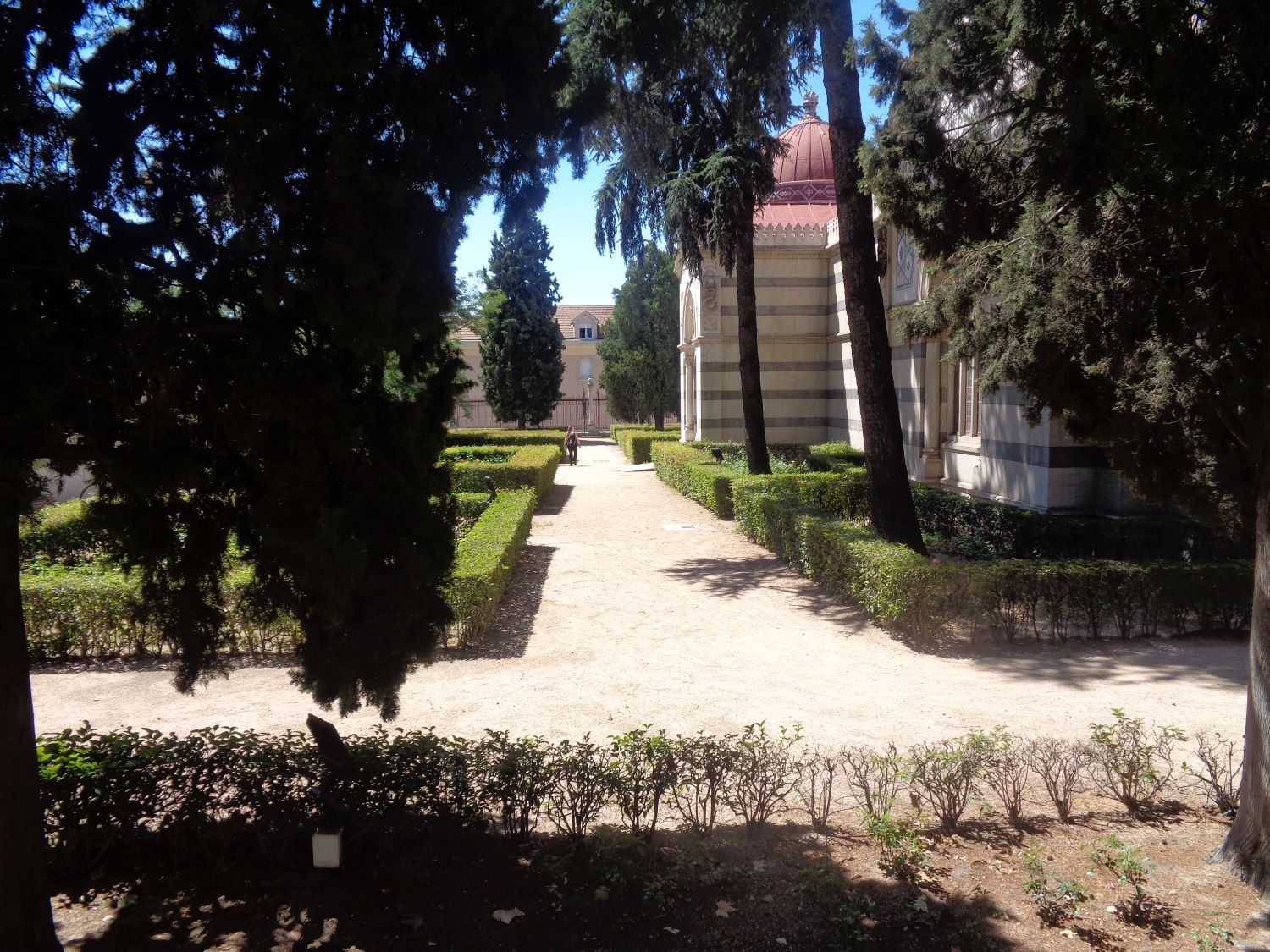
In 1891 the project began to be built, of which only the pantheon and the belltower would be built. The pantheon was erected between 1892 and 1899, giving the works to be completed in this last year for the high cost. The cloister/pantheon is square, with three galleries with arcades and stained glass and two semi -expiration domes in the corners. On the entrance door there is a pediment. Inside there is a small garden where the joint mausoleum is located. The galleries each have a central door through which the garden can be accessed. The whole set is surrounded by an iron fence. In 1970, in the field that was free between both buildings, the School Our Lady of Atocha was built, leaving the belltower, which is no longer accessible, Finally on October 2022, after the approval of the Democratic Memory Law, it is call the Pantheon of Spain, The pantheon is accessed by Calle Julián Gayarre no 3 at the corner of the Paseo de la Reina Cristina, no 4. There is another access for people with reduced mobility from the Paseo de la Reina Cristina , The visit is free. It can take you there but we walked as parking was nearby, Bus lines 10 14 26 32 C1 stop at the Paseo de la Reina Cristina, no, 4) and bus lines 24 37 54 57 and 141 stop on the Calle Ciudad de Barcelona, no, 6,Metro: Atocha-Renfe Station exit Alfonso XII departure, and Menéndez Pelayo station Gutemberg, of Line 1. And Cercanias train of Atocha train station.
The National Heritage of Spain on the Panthéon of Spain : https://www.patrimonionacional.es/en/visita/pantheon-spain
The Madrid tourist office on the Pantheon of Spain: https://www.esmadrid.com/en/tourist-information/panteon-espana
There you go folks , another wonderful nostalgic, sentimental trip to my dear Spain, Madrid is always nostalgic sentimental words cannot describe it ! This is a vibrant cosmopolitan cities of friendly faces and smiles to share in long conversations about life and more ; I love it, And these places are part of my life forever ! We will be back ,eventually!, Again, hope you enjoy this post on the Pantheon of Spain in Madrid, part I !! as I
And remember, happy travels, good health, and many cheers to all !!!

 Paris1972-Versailles2003