
Never amazed me in my travels the beauty of my dear Spain. This is deep roots, in fact when visitors comes to Spain or hear about it, what they really see / hear is Andalucia. You heard of this city Màlaga, and I am lucky enough to find me this paper old pictures that can put in my blog for the memories of always. It is the second most populous city in Andalusia and the sixth in Spain, as well as the largest among those that are not regional capitals. As we say Spain is everything under the sun !!! I came to it long time ago, and many friends and honorary member of peñas or supporting groups of the Real Madrid CF in Malaga ! Still in touch with all of them, Therefore, let me tell you a bit on this is Malaga !!! Hope you enjoy it as I.
The main highway here is done along the tourist coast on the A7 E15 highway that connect Algeciras, Màlaga, Ameria, Murcia, Alicante, Valencia and Barcelona, I had easier as came from visiting another friend in Granada (see post) and came from there along the A92 highway which at Salinas becomes the A92M same road and on exit/salida 24 connects with the A45 highway continue to exit/salida 142B to connect with the A7 carretera de Cadiz go under tunnel San José continue same road Autovia del Mediterraneo to exit/salida 981A onto Avenida Camaron de la Isla ,then turn left on Camino del Colmenar road past by monumento Don Bosco and continue to calle Cristo de la Epidemia bear left on Plaza Victoria with the monkeys garden or Jardines de los Monos, and continue on Calle Victoria ,then bear left on Calle Mundo Nuevo continue bearing rigth onto Paseo Don Juan Temboury at Plaza de la Aduena bear right onto Calle Cister to the Catedral and found on street parking by nearby calle Cortina del Muelle,
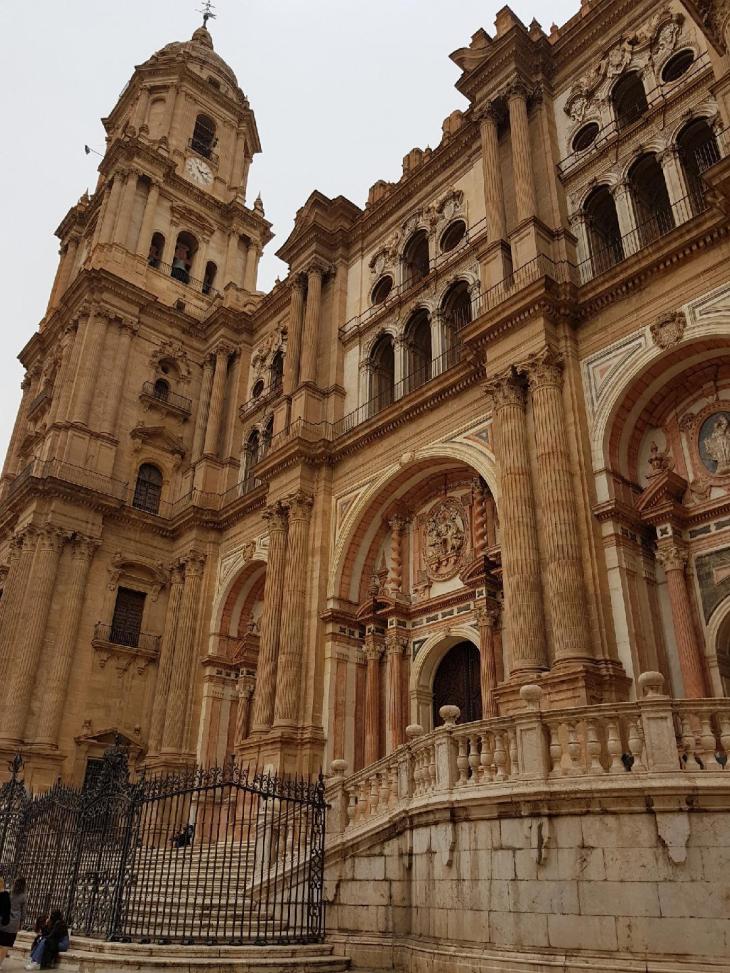
Officially, the Santa Iglesia Catedral Basílica of the Encarnación , one of the wonders of the Renaissance in Andalusia and Spain. The cathedral, located in the historic center of the city, is seen from any point in the city. It is a majestic cathedral of great architectural beauty and great artistic wealth. It was built on the old main mosque from the 16C until the 17C. The architectural whole is however unfinished, since it is missing a tower. This is why in Málaga it is affectionately called Manquita (“the little crippled”). It presents a form of Latin cross with three naves and an ambulatory. Its interior is populated by works and artistic expressions, such as Giedo de Vergara master paintings. In addition, its choir is a reference to the Spanish baroque in the 17C. This construction occupies the site of an old mosque-Aljama. On the order of Catholic kings, work began during the first half of the 16C, in Gothic style, and continued in the 17-18C. It has its own gardens as well as a magnificent patio. Note the Renaissance and Baroque influences inside the cathedral , and especially notice the stalls of the choir 17C in the central nave and, above all, the sculpture of Pedro de Mena. The chapels are also very interesting like that of the Encarnación, which gives its name to the cathedral.
Other things to see and are a few days as was on a special visit missed a lot need to time to be back, eventually. The Alameda Principal, the main thoroughfare of the historic center, was laid out during the 18C, here you see the house where the Danish writer Hans Christian Andersen stayed during his time in the city, for which a statue stands in his honor. The Calle Marqués de Larios, a legacy of the city’s 19C urban planning, is a street opened in 1891, originally created to connect the Plaza Mayor (now Plaza de la Constitución) with the Port of Malaga. Lined with a series of buildings in a style inspired by the Chicago School, it is the setting for the city’s main events. Between Plaza de la Merced and Plaza de la Aduana lies Calle Alcazabilla. This street encompasses the Customs Palace, the entrance to the Alcazaba fortress, the Roman Theatre, part of the city’s Jewish quarter, the wooded garden behind the Picasso Museum, and the Palace of the Counts of Buenavista, whose basement contains remains of the city’s ancient Phoenician wall. Four churches are located within the old city walls: the Church of San Juan, the Church of the Martyrs, the Church of Santiago, and the Church of San Lázaro. Next to the cathedral stands the Church of the Sagrario, with its Isabelline Gothic elements, built in the 16C. The 17C Church of Santo Cristo de la Salud, currently the headquarters of the Association of Holy Week Brotherhoods, the Historical Archive, and the Brotherhood Museum. The Atarazanas Market, an iron building incorporating a 14C Nasrid arch, and the La Malagueta bullring are all notable buildings. Pre-19C structures include the Salinas Palace, of Muslim origin; the Buenavista Palace and the Villalón Palace, both from the 16C; the Zea-Salvatierra Palace, from the 17C; the Palace of the Marquis of Sonora; the Baroque House of the Atarazanas; the Valdeflores Palace; the Consulate House; and the Villalcázar Palace, also from the 17C.
The Museum of Málaga is a merger of the Málaga Museum of Fine Arts, founded in 1913, and the Málaga Provincial Archaeological Museum, from 1947, and is housed in the Customs Palace. The Carmen Thyssen Museum, located in the 16C Villalón Palace, houses 267 works from the Carmen Thyssen-Bornemisza Collection and offers a comprehensive overview of 19C Spanish painting. The Centre Pompidou’s collection includes works by Frida Kahlo, Picasso, Bacon, Magritte, Léger, Max Ernst, de Chirico, Giacometti, Brancusi, Marc Chagall, Julio González, Joan Miró, and Antoni Tàpies, among others. The Picasso Museum Málaga, located in the Renaissance-era Palace of the Counts of Buenavista, boasts 276 works spanning eight decades of the Málaga-born genius Pablo Picasso’s creative output, as well as an ambitious program of temporary exhibitions. The Picasso Foundation Birthplace Museum is another exhibition space dedicated to Pablo Picasso. Located in the Plaza de la Merced, in the building where Picasso was born and spent his childhood, it treasures childhood and family mementos of the painter. Along the border with Torremolinos are the beaches of San Julián, Guadalmar, and Guadalhorce, the latter located within a natural area. These are low-lying, semi-urban beaches with dark sand. Within the town itself and west of the port lie the beaches of La Misericordia, San Andrés, and Huelin. These are extensive beaches with a high occupancy rate. On the other side of the port are the beaches of La Malagueta and La Caleta, the former boasting a Blue Flag. Further east lie the Baños del Carmen and the beaches of Pedregalejo, El Palo, and El Candado.
A bit of history I like tell us that it was founded by the Phoenicians in the 8C BC, it is one of the oldest cities in Europe. It was first a federated municipality, then a Latin-right municipality of the Roman Empire, and a prosperous Andalusian medina, four times the capital of its own kingdom, which was incorporated into the Crown of Castile in 1487. The scene of one of the bloodiest episodes of the Spanish Civil War and a key player in the explosion of the tourism boom of the 1960s and 70s, it is currently a significant entertainment, economic, and cultural center, as well as a communications hub on the Mediterranean coast. After the Arab conquest by Musa’s son, Abd al-Aziz, Málaga became a flourishing city surrounded by a walled enclosure, alongside which lay the Genoese merchant quarters and the Jewish quarter. Málaga became the capital of the Hammudid Taifa, as well as of three other short-lived kingdoms later on. Traces of this era remain in the historic center and in two of its main monuments: the Alcazaba and Gibralfaro Castle. The capture of the city by the Catholic Monarchs in 1487 was a bloody episode in the final war against the Nasrid Kingdom of Granada. The siege of the city was one of the longest of the Reconquista, lasting six months and cutting off its food supply. The city surrendered on August 18, 1487 and the monarchs entered triumphantly the following day.
In the early years of the 19C, Málaga would play a leading role in the Spanish War of Independence;(Peninsular War) , it would contribute decisively to the first victory of a European army in open battle against Napoleon’s troops at the Battle of Bailén, with thousands of volunteers and, at the head of the Spanish troops, their Governor, General Teodoro Reding. In 1810, Napoleonic troops again penetrated southern Spain, and the city was occupied until 1812. It was forced to pay heavy taxes for being the only southern capital to rebel against them. In 1931, following the proclamation of the Second Spanish Republic, Málaga was the Spanish city most affected by the tragic events perpetrated by anticlericals and left-wing extremists between May 10 and 13,1931 ,known as the burning of the convents. In 1933, Málaga became the first deputy of the Communist Party of Spain. Due to this, and the large number of active militants associated with socialism, anarchism, and communism, Málaga was known during this period as “Red Málaga,” despite the presence of numerous liberal and conservative sectors in the city. After the outbreak of the Spanish Civil War, the city remained under Republican control until early 1937, when the Francoist army, with the help of Italian volunteers and under the command of General Queipo de Llano, launched an offensive against the city, which was occupied on February 7, 1937. During the dictatorship of Francisco Franco, Málaga experienced significant economic expansion. Demographic, driven by immigration from various parts of the province to the city itself, and economic, fueled by the Costa del Sol tourism boom, were key factors in Málaga’s growth. With the establishment of the parliamentary monarchy, the 1978 Constitution, and the dawn of the new century, Málaga experienced the cultural and economic development of southern Spain and the Mediterranean, becoming the most economically active city in all of Andalusia.
The Malaga tourist office on its heritage see Cathedral : https://visita.malaga.eu/en/what-to-see-and-do/culture/historic-monuments/monuments
The official Cathedral of Malaga : https://malagacatedral.com/la-catedral/
The City of Màlaga on its history : https://www.malaga.eu/la-ciudad/historia-de-la-ciudad/
The Spain National Tourist office on Màlaga : https://www.spain.info/en/destination/malaga/
The Andalucia region tourist office on Màlaga : https://en.andalucia.org/places-to-visit/malaga/malaga/
The province of Màlaga tourist office on Màlaga: https://www.malaga.es/es/laprovincia/localizacion/3325/malaga?cnl=94
There you go folks, one of the best of my Spain, and plenty to see in architecture, history, personalities, and gastronomy/wines you should be there and we will be back! Again,hope you enjoy this post on this is Malaga !!! as I
And remember, happy travels, good health, and many cheers to all !!!

 Paris1972-Versailles2003
Che, aparte de que estoy enamorado de Sevilla, Granada sería la ciudad de Andalucía que escogería para vivir… Aunque toda Andalucía me encanta. Muy buenas fotos!
LikeLiked by 1 person
A mi gusta Granada y Malaga soy miembro honorario de la peña del Real Madrid alli..chauu
LikeLiked by 1 person
Que bien.
LikeLiked by 1 person