
Another wonderful experience in my beloved Spain. Driven by it so many times eventually several years back decided to come in and it has been a stop ever since. Jaca in the heart of Aragon! This is a post done out of me again finding some pictures that should be in my blog, Of course, plenty more written on Jaca in my blog. The City is in the province of Huesca, and autonomous community of Aragon , Therefore, here is more of the curiosities of Jaca, part III !!! Hope you enjoy this post as I.
The Citadel of Jaca aka Saint Peter’s castle (see full post) is protected upstream by the forts of the Coll de Ladrones or thieves and the turret of the Riflemen. It testifies to the diffusion of the military art to defend the place à la Vauban. The citadel of Jaca is a pentagonal construction, with a defensive rampart in every corner communicated by round paths, which king Felipe II, in the 17C, ordered to erect in a suburb of Jaca because he feared an Invasion of the French heretics…. Its construction is framed in the defense strategy adopted by king Felipe II after the invasion of the Tena Valley by troops from the south of France in January 1592, and also as a soothing element of possible internal revolts. It was conceived as the central axis of a thick network of Pyrenean defenses in which were integrated the towers of Ansó, Hecho, La Espelunga (Canfranc) and Santa Elena (Biescas-Valley of Tena), in addition to the small castles of Berdún and Canfranc. Its construction began in 1595, and was under king Felipe III, in 1613, that the access façade was completed. However, the digging of ditches and other collateral projects were longer, and still continued towards the end of the 18C.

The fortress has a five-pointed star plant and is preserved practically intact since its construction. It observes the characteristics of a fortress of Italian trace, maintaining all its elements; Moat, bastions, escarpments and buttresses, barracks for the lodging of the troop, powders, tunnels.The access is made crossing the moat through a bridge of three arches plus a drawbridge to access the door of the enclosure, Herrerian style of great artistic interest. Do not forget to see the military miniature museum inside a jewel for the aficionado and collector and just plain history buff like me:love it!! More than 32000 figurines in 23 showcases retracing the military history of our days in figurines that goes down to 20 mm or about 0,8 inch! All in order from the first great armies of the world,from the crusades to the 18C, towards WWI, Spanish Civil War, towards WWII, and towards Peace. A must to see while there , perhaps the main thing to see there!

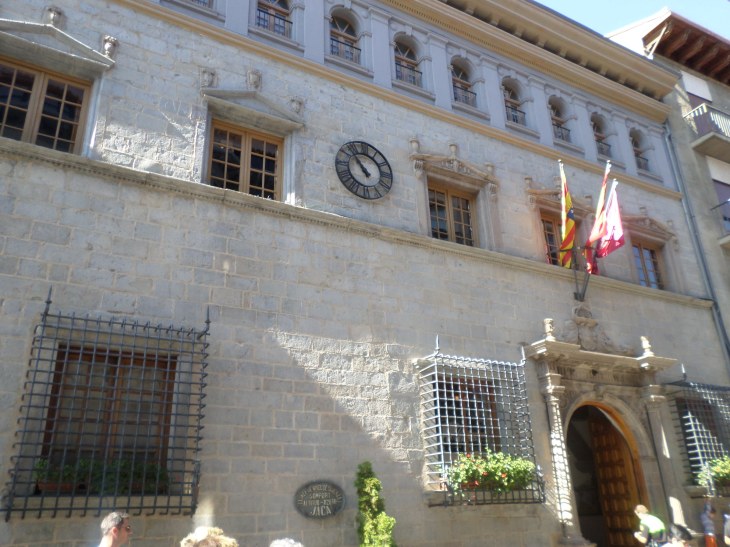
A bit on the City/Town Hall of Jaca. Since 1486, there is evidence that in this urban route the civil power was located since at that time the Council acquired the necessary lots for building the primitive City Council. Inside that building, the municipal historical archive is preserved today, where documents are stored from 1042.Paraciorally, in full rebirth, in 1544, it was agreed to expand the old headquarters of the Council with the construction of the building that is seen today in day. Renaissance style inside. In the lower body opens the magnificent cover that shows the splendor of the stallsman presided by the city shield. In the second body, the noble plant opens five windows whose frontons contain the Aragon bars. In this plant, one of its interior rooms remembers with its name the council of one hundred, formed by one hundred good men who helped govern the city since 1238. The third body, which was added to the beginning of the 20C, when the old Alero, forms a typically Aragonese gallery of windows. The City Council, in addition to being the headquarters of the local government, also guard an important cultural heritage: the sculpted eardrum coming from the Romanesque hermitage of Sarsa and dated in the 12C, the famous book of The 13C chain, the bells of the clock tower made by Bartolomé de la Rosada in 1595 and some solid silver parade maces of the 16C.
A bit of history of Jaca tell us that Iacca was inhabited by the Iberian people of the Iceta, was the first fortress conquered by the Romans in Hispania. Jaca was the first capital of the Kingdom of Aragon, the first city that acclaimed King to Ramiro II the monk, the first city that revolted in favor of the Republic in 1930. Jaca is for all this a unique city, sung by own and strangers, an exciting world visited by kings and pilgrims, an engine of progress to which the Spanish monarchy ended up awarding – in the 17C with the titles of very noble, very loyal and very winning city of Jaca.
The official Ciudadela of Jaca: https://ciudadeladejaca.es/
The Jaca miniature museum in the Ciudadela: https://museominiaturasjaca.es/
The city of Jaca on the Ciudadela:https://www.jaca.com/ciudadela.php
A good unofficial tourist site on Jaca : https://www.jaca.com/turismo.php
The metro area Jacetania on Jaca history/heritage: https://www.turismojacetania.com/lugares.php?idio=en&Id=120
The Huesca province tourist office on Jaca: https://descubrehuesca.com/jaca-referente-turistico-del-pirineo/
The Aragon region tourist office on Jaca: https://www.turismodearagon.com/en/ficha/jaca/
There you go folks, a wonderful, terrific, no words combination to see in Jaca. There are many others do see my blog ! Again;hope you enjoy this post on the curiosities of Jaca, part III as I
And remember, happy travels, good health and many cheers to all !!!

 Paris1972-Versailles2003