
Once again, found several pictures not in my blog from this wonderful cathedral that even after two posts, feels needs more, Even if it is a big task on writing about this awesome cathedral I like to give you and me a bit more always more of it, This is awesome a must to see really sublime, there is always more I just do my five cents on it, I had spent days here over the last few years of my life,and coming back is always wonderful; the city is wonderful, the Cathedral is heavens.I used to come more often when family lived just outside the City, now the last uncle is gone and after the last events in our world really needs a return for memories’s sake, last was 2017, For reference the Catedral Santa Maria, primada de Toledo , part III !!! is of course in Toledo, province of Toledo, in the autonomous community of Castilla La Mancha, Kingdom of Spain. Hope you enjoy the post as I.
The Catedral Primada Santa Maria or St Mary’s Primate Cathedral is 120 meters long by 59 meters wide and has five nave in addition to a cruiser aisle and dome as well as a cloister, 88 columns, and 72 vaults. The main façade has three gates such as Puerta del Perdon (Forgiveness), Puerta del Juicio Final (final judgement), to the right, and Puerta del Infierno (hell) to the left. There is , also the Puerta del Reloj (Clock) oldest from early 14C; the Puerta de los Leones (Lions) is 15C .Other gates are Puerta Llana (flat) , Portada de Santa Catalina ( St Catherine), and Puerta de la Presentacion (Presentation). The Bell tower is 92 meters high and finalized in 1422 in Gothic style. The construction of St Mary’s Cathedral began in 1226 with white stone in Gothic style;finished in 1493.
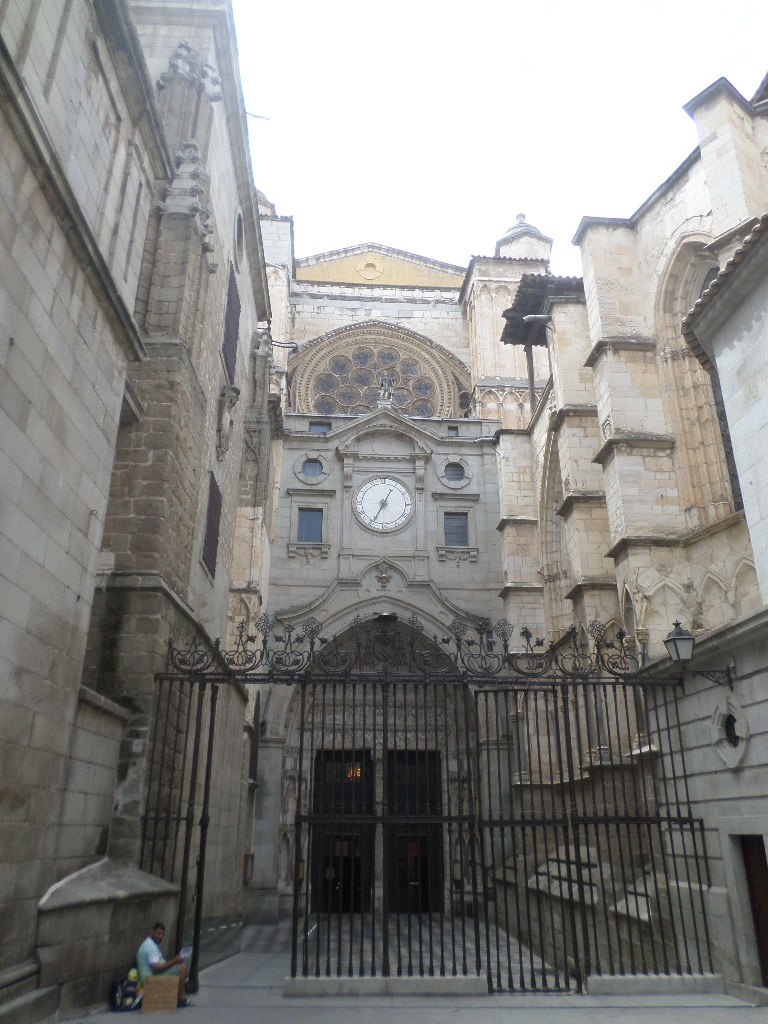
The Sacristia or sacristy is a large space that also has other adjoining rooms: ante-sacristy, dressing room and clothing collection. The ante-sacristy has a rectangular plan. It is a room decorated with large paintings ,and a wide variety of luxuriously framed canvases are displayed on the walls, forming an authentic art gallery of great value. The most appreciated are the fifteen of El Greco, especially the Expolio, which is the altarpiece of the back altar, framed in marble and two Corinthian columns. The other paintings belong to several artists such as Juan de Borgoña, Anton van Dyck, Goya, Bassano el Mozo and some others. In addition to the paintings, there are a series of valuable objects in the sacristy headed by the Rich Bible of Saint Louis, King of France, dating from 1250, with 750 full-size miniatures and 5,000 spread across the handwritten pages of the three volumes. It was an acquisition of king Alfonso X., In the next room is the locker room whose ceiling is painted by Claudio Coello and José Donoso. In this space some good paintings are kept, replicas of Titian (Pope Paul III), Velázquez (Cardinal Gaspar de Borja) and Giovanni Bellini (The Burial of Christ). There is another series of canvases by great artists whose set constitutes an authentic museum. There are a total of 70 pieces; pluvial capes from the 16-17C. The chapel and an embroidered band of the great cape worn by Charles I of Spain at his coronation in Aachen are preserved. An Arab standard won in the Battle of Salado is on display. The collection of tapestries exceeds 70 copies. Many are cartoons by Rubens, a gift from Archbishop Fernández Portocarrero, who commissioned them specifically for the cathedral. Some are displayed on the walls of the cathedral during the days of the Corpus Christi festival.

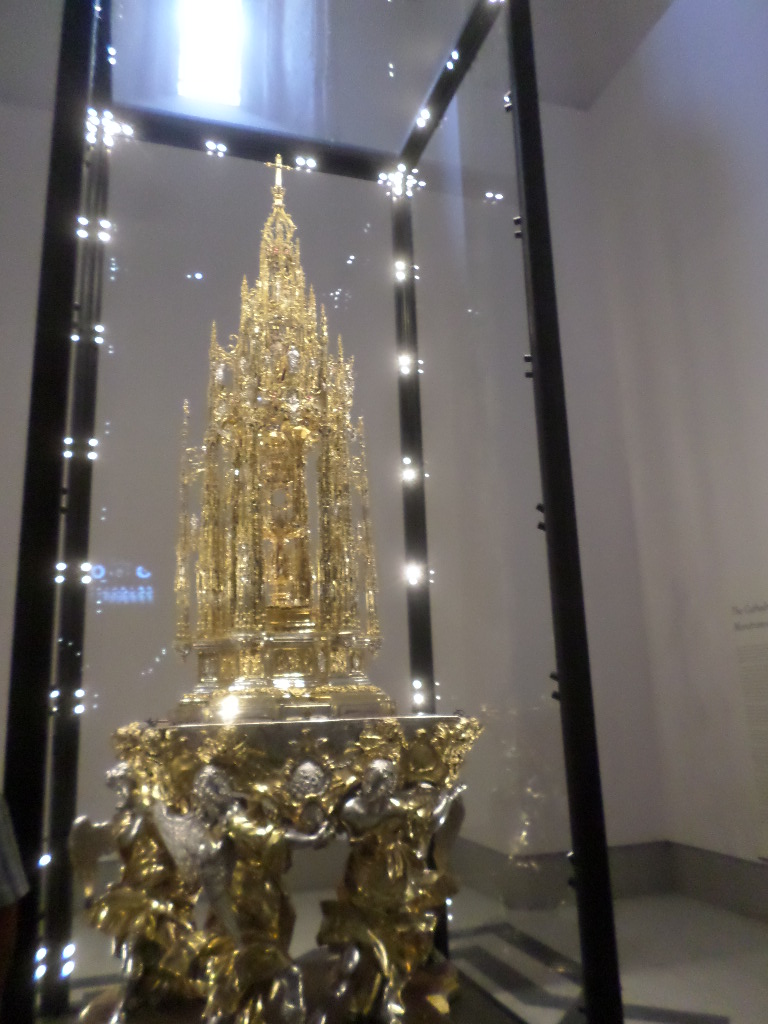
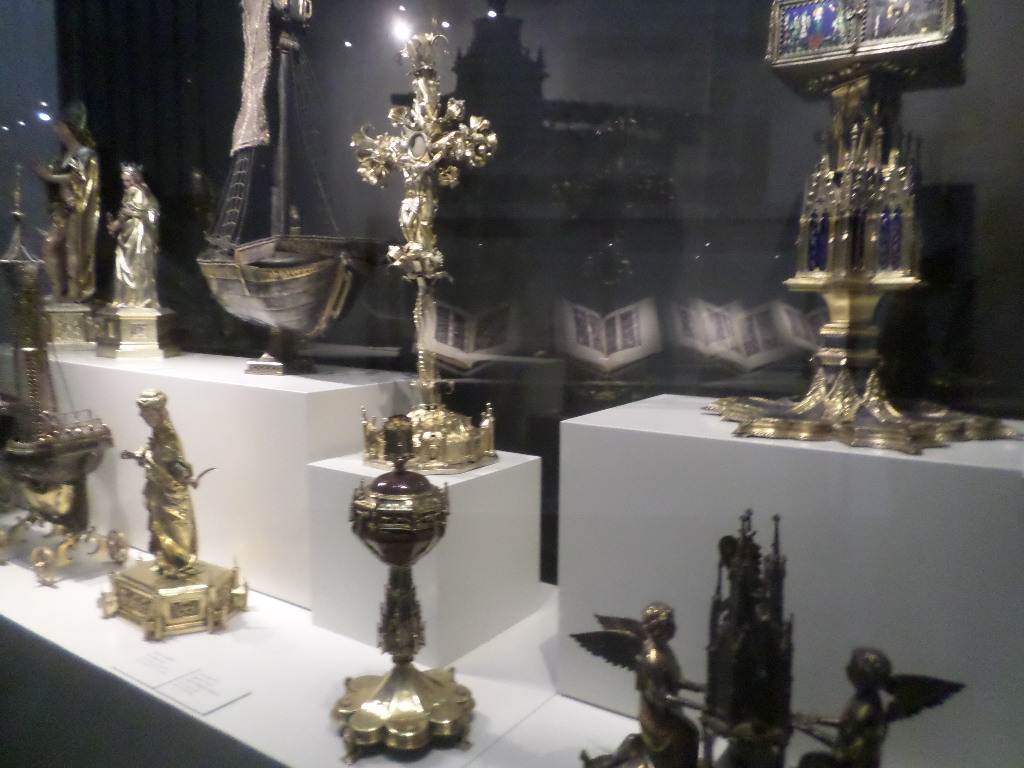
The Tesoro or treasury is located in the space bordering the Mozárabe chapel, on the north side, just below the tower, in what was the sacristy of the chapel of the New Kings before its transfer. Inside there are multiple display cases that keep the cathedral treasury consisting of liturgical objects, reliquaries, crosiers, clothes, books, etc. In one of the display cases two treasures of historical value are kept: a pectoral cross, a gift from Pope John XXIII, and a chalice, a gift from Marshal Petain (head of state of France from 1940 to 1944). Another of the most precious treasures is the Bible that Saint Louis, King of France, gave to this cathedral in the 13C. There are three volumes written in Latin and exquisitely decorated with miniatures made from more than 5,000 gold leaves. It is a moralized Bible, that is, it relates the biblical scenes with the customs of the historical moment in which this work was carried out. A curious work of some value is the cross painted on wood by the Italian painter Fra Angelico. It has the originality of being painted on both sides: on the front you can see Christ still alive and on the back, dead Christ. It was a gift given in 1936 by the then Head of the Italian Government Benito Mussolini. The most valuable and important piece is the monumental custody of Enrique de Arfe, a work from 1517-1524.
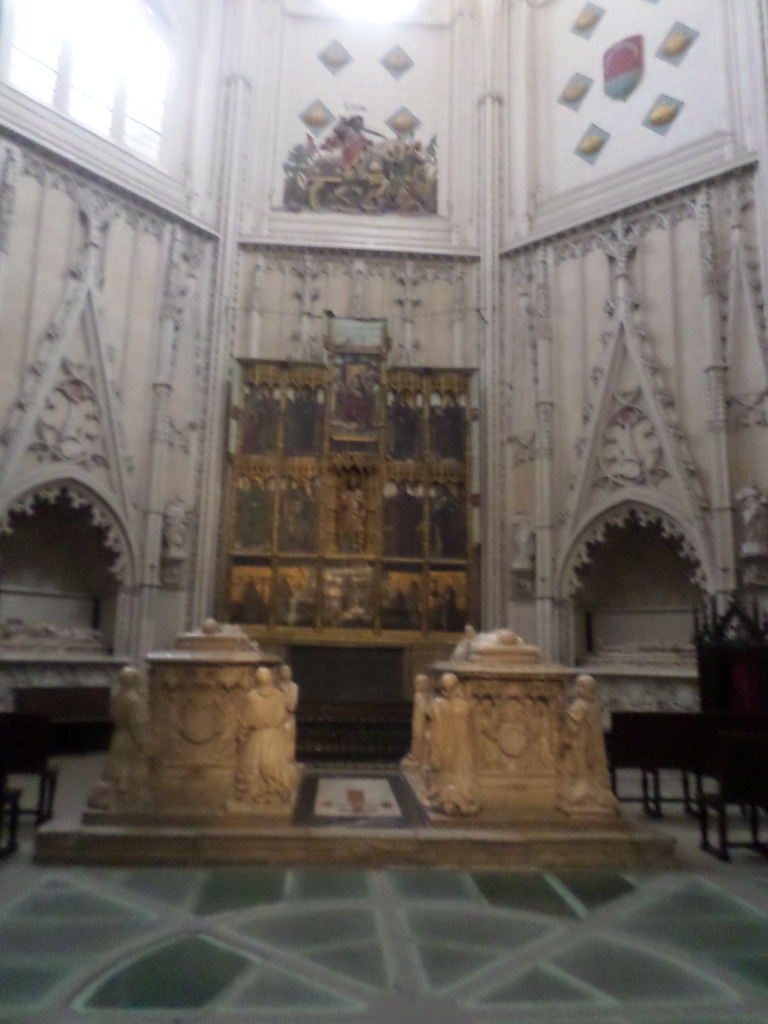
The Capilla de Santiago or Chapel of St James, also, called the chapel of Álvaro de Luna because this historical figure was the one who had it built and who founded it as a burial place for him and his family. It is one of the largest in the ambulatory as it occupies the space of three of the old ones, one large and two small; It has an octagonal plan and a very refined and select flamboyant style, one of the best examples found in Spain.
The Capilla de Doña Teresa de Haro or.Chapel of Doña Teresa de Haro. Also known as Cristo de las Cucharas in reference to the ladles of the López de Padilla family coat of arms. Founded by Teresa de Haro, wife of Marshal Diego López de Padilla,

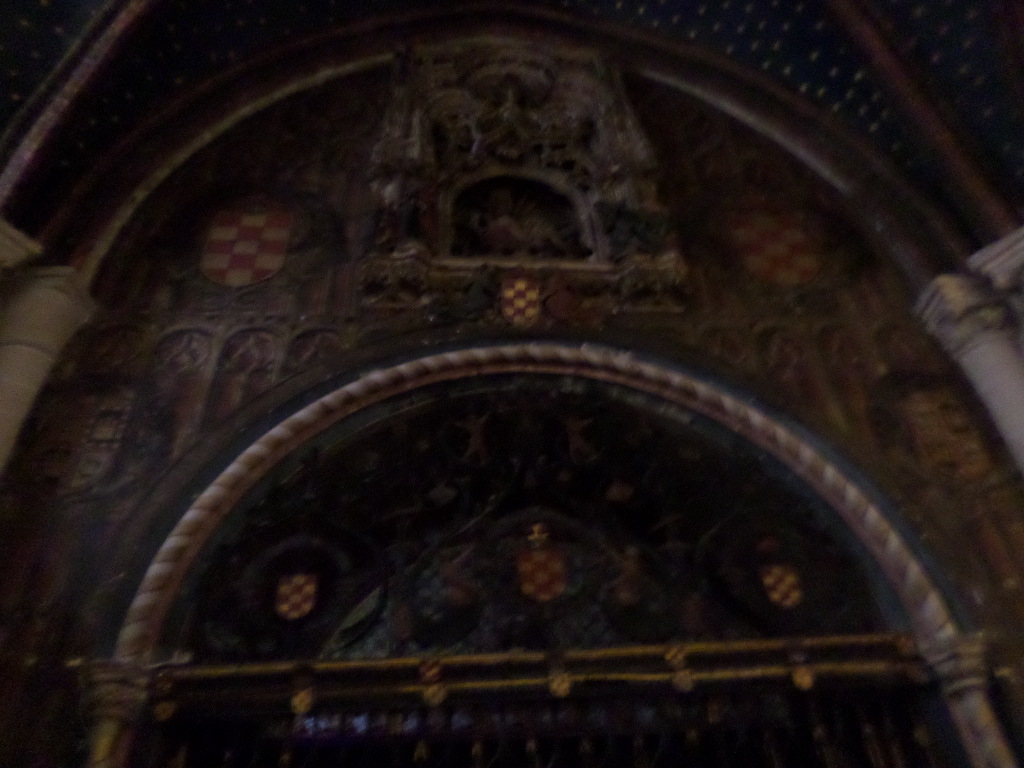
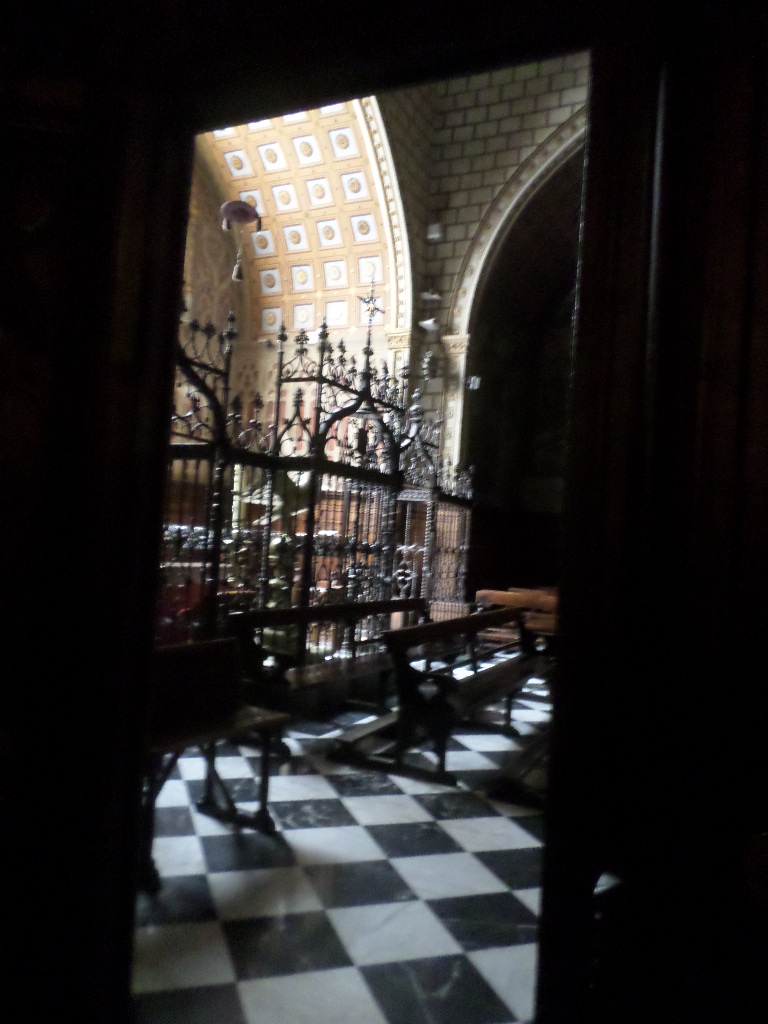
The Capilla Mozarabe or Mozarabic Chapel is located in the corner of the south façade, housed inside the beginning of a tower that was never built. Its original name, given by Cardinal Cisneros, was the Corpus Christi Chapel in the year 1500 and its purpose from the beginning was the maintenance of the Hispano-Mozarabic rite. It had to be taken into account that, already in 1101, Alfonso VI had given the Mozarabs of Toledo a privilege in tribute and in 1371, Henry II of Castile confirmed it. When finished, the Mozarabic chapel remained as a square plan under an octagonal dome, possibly with a Mudejar-style coffered ceiling that was lost to time. The current dome is from the 17C, the work of El Greco’s son, Jorge Manuel Theotocópuli. The Gothic grille that leads to the interior of the chapel (1524); it has, among other elements of ornamentation, the shields of Cisneros, The altar is made of bronze and marble of various colors from the 18C. In the center you can see an 18C mosaic image of the Virgin and Child. Above the altarpiece there is a crucifix made of one piece, carved from the root of Mexican fennel, brought by the Dominican friar Gabriel de San José in 1590. Another grille in Gothic style, the work of Julio Pascual from Toledo, made with ancient methods, separates the choir from the rest of the stay. The Hispano-Mozarabic rite mass had its origins in the first Christians of the peninsula and was initially called the Hispano-Roman rite, also during the Visigoth period. The unification of the different rites by Pope Gregory VII did not prevent Toledo from maintaining its own rite, (eventually called Hispano-Mozarabic) that took its raison d’être from the old Hispano-Roman. In fact, the disappearance of the rite in its largest area, Andalusia, left Toledo as almost the only place where the cult was practiced, reduced to six parishes, although in fact only four maintained it. It is also kept in the Talavera chapel of the old cathedral of Salamanca.
The construction of the Claustro or Cloister was begun in 1389, and was completed in 1425. In the 15C, its walls were covered with frescoes by Pedro Berruguete and Comontes, representing the Life and Passion of Christ. Due to humidity and the inclemency of the weather they deteriorated and from what remained, it was produced a new series on the lives of the saints of Toledo (1776- 1787). It is a series of eleven frescoes: Preaching of Saint Eugene; Beheading of Saint Eugene (1776-1777); Translation of the body of Saint Eugene (1779); Revelation of Saint Denis to Hercoldo (1777); The Charity of Saint Casilde (1779); The Death of Saint Casilde; The Miracle of Saint Casilde (1779); The Exhortation of Saint Eulogus (1784); The Rape and Martyrdom of the Holy Child of the Guard (1784); Saint Ildefonso and Saint Julian inspired by the Holy Spirit (1785) and The Alms of Saint Eladio (1787). Opposite the painting which depicts the moving of the relics of Saint Eugene, there is a column with a ball and a cross with stone fragments, which was discovered in 1591 near Saint John of Penance, believed to be the first stone of the ancient Visigoth church later transformed into a mosque and which is currently this cathedral. It is also possible to contemplate other paintings by Francisco Bayeu which represent: Charity, Denunciation and The Death of Saint Casilde. The door leading to the high cloister built in 1500 is next to it.

The official Catedral Primada de Toledo: https://www.catedralprimada.es/
The Toledo Tourist office on the Cathedral: https://turismo.toledo.es/recursos/museos-y-monumentos/id1450-santa-iglesia-catedral-primada-de-toledo.html
The Castilla la Mancha region Tourist office on the Cathedral: http://en.www.turismocastillalamancha.es/patrimonio/catedral-primada-23364/descripcion/
This is a must to visit here, if only one thing to see in Toledo this must be it. Again do not missed it. I have come to Toledo sometimes just walk around it ,and others go inside, always a great satisfaction of seeing it. Catedral Primada de España, Catedral Santa Maria of Toledo.
There you go folks, plenty to go around and see this jewel of our time and forever beautiful,,This is the Saint Mary’s Cathedral, primate cathedral of Toledo and Spain, go see it ! Again, hope you enjoy the post on the Catedral Santa Maria of Toledo, part III as I.
And remember, happy travels, good health, and many cheers to all !!!

 Paris1972-Versailles2003