
I bring you again to a wonderful City of my dear Spain, I by pass the City many times on my route between France and Spain, Incidentilly, the first time in this City was while on the beaches of the Médoc in Bordeaux and we decided back in 1992 to come down for a closer look always in my road warrior mode. It has been as the old saying said, the beginning of a beautiful friendship of San Sebastian, The choices are endless and very nice spots as we walked all over once in town, I like to bring out a new older pictures from my vault that I feel needed to be in my blog, for the memories of always, Therefore, Let me tell you about the curiosities of San Sebastiàn, part II !!! Hope you enjoy it as I.
This is approaching San Sebastian on the AP 8 highway/motorway past Exit 12 interchange between AP-8 and GI-20: San Sebastián, Errenteria, Pasaia, the picture is by about km 15, The Cantabrian Highway or AP-8 is a toll highway that extends along the coast of the Basque Country (Spain). It begins at the junction with the French A-63 highway, at the so-called Biriatou International Bridge with the border with France in Behovia, Irún neighborhood to Bilbao, where it connects with the AP-68. It has a length of 116 km, of which 37 km are triple lanes in the Bilbao – Durango direction, as well as the San Sebastián (Arriceta) – Orio section and the Durango – Éibar triple carriageway under construction. In addition, on the information signs of the second belt of San Sebastián it can be considered that the AP-1 runs along the AP-8 from France to junction 15A where it separates towards Vitoria. Indeed and here we veer towards Burgos, and then Madrid, This is a toll road, on this stretch you pay 2,95 euros at Behobia and 2,60 euros at Zarautz.
The group Itinere handles this section of road on the AP 8 : https://www.grupoitinere.com/portfolio-item/08-gebisa-2/
The Hotel Maria Cristina ,now part of Marriott , The Luxury Collection property, It was name after the regent queen of Alfonso XII of Spain, Since its opening in 1912, the hotel has been closely linked to the history and culture of San Sebastian. It’s the main accommodation for the stars who go to the San Sebastián International Film Festival. Very diverse and varied characters such as Bette Davis, Léon Trotsky, Mata Hari, Maurice Ravel, Audrey Hepburn, Alfred Hitchcock, Steven Spielberg and Mick Jagger were hosted here. In fact, among its most beloved anecdotes is the last photograph taken of Bette Davis, but ,also, because the hotel has interwoven its history with kings and dukes, presidents, writers and even an emperor of Japan. It hosts within its walls one of the best restaurants in the world. the Tse Yang San Sebastián Asian Restaurant and the Dry San Sebastián bar.
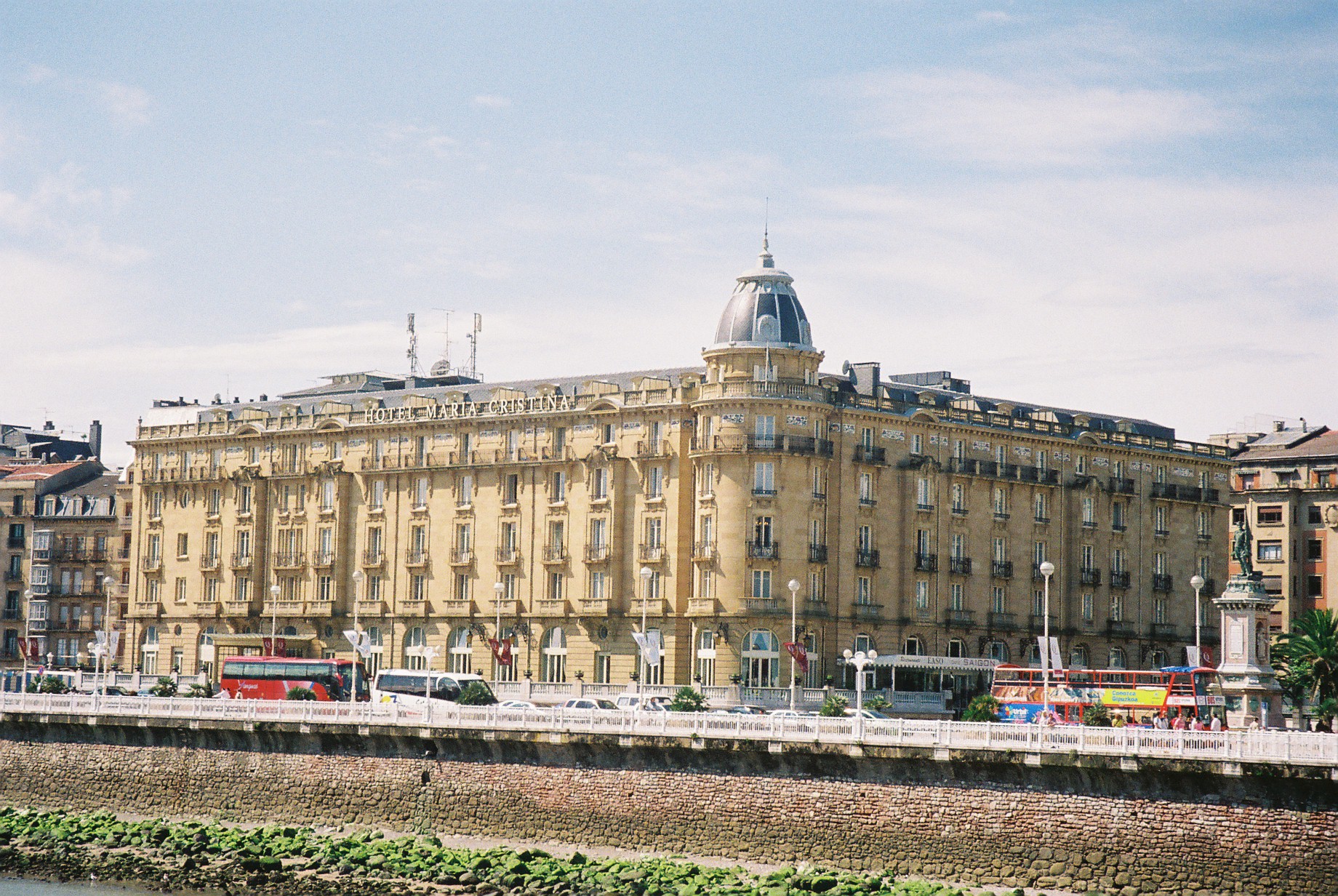
A bit more of the history I like tell us that at the end of the 19C, the coastal town at the southern tip of the Bay of Biscay became a popular destination for royalty and aristocrats who came to enjoy the sun and the recent therapeutic virtues of sea swimming. San Sebastian had to be dotted with modern and luxurious facilities to meet the expectations of its discerning guests. work on the Hotel Maria Cristina began in 1909, simultaneously on the theater and the hotel. The theater was designed by architect Francisco de Urcola, based on other recently built European theaters. The hotel, for its part, was designed by Charles Mewes, author of several Ritz hotels in Europe, such as, for example, those in Madrid and Paris. In 1912, Queen Maria Cristina inaugurated the Victoria Eugenia Theater (see post), and the María Cristina Hotel. From then on, these two buildings formed one of the most prestigious complexes in the city. Its period of splendor coincided with the belle époque donostiarra, that is to say, the period of the Great War or WWI, until the beginning of the 1930s during which San Sebastian welcomed the Spanish aristocracy and bourgeoisie. Overlooking the Urumea River and with views of the Cantabrian Sea and the Kursaal Congress Palace and Auditorium, this elegant stone mansion has reigned in the heart of Donosti for 111 years as a symbol of luxury, elegance and hospitality. Durant In the 1950s a new wing was added to the building, which took a U shape instead of the original L. In 1982, the María Cristina Hotel was transferred to the management of the City/town hall. During the years 1987 and 1988, it closed its doors to be restored and acquire the category of 5 stars (until then 4). In 2016, the American hotel chain Marriott approved the merger with Starwood Hotels & Resorts, creating the largest accommodation operator in the world.
The official Hotel Maria Cristina: https://www.marriott.com/en-us/hotels/easlc-hotel-maria-cristina-a-luxury-collection-hotel-san-sebastian/overview/
The San Sebastiàn Tourist office on the Hotel Maria Cristina : https://www.sansebastianturismoa.eus/en/sleep/5-star-hotels?id=505&ids=297
There you go folks, another wonderful spot in this wonderful City of San Sebastian or Donostia in basque, that I would love to visit again, eventually, Memories of my dear Spain ! Again, hope you enjoy the post on the curiosities of San Sebastian, part II as I.
And remember, happy travels, good health, and many cheers to all !!!

 Paris1972-Versailles2003