
Looking back in my blog once again feel not given credit to this area enough. I like to tell you that I have several posts on San Lorenzo de El Escorial and its monuments, especially the monastery. However , let me update this older post splitting the two houses here with new text and links. Therefore, here is my take on the Casita del Principe of San Lorenzo de El Escorial !!! Hope you enjoy the post as I
The Casita del Principe, located in the town of San Lorenzo de El Escorial in the Comunidad de Madrid region. The house is one of the residences of the Spanish Royal Family. It is an 18C building, located in the town of San Lorenzo de El Escorial, in the Community of Madrid as well. It was built between 1771 and 1775, based on a design by Juan de Villanueva, one of the most important architects of Spanish neo classicism. It was chosen as a recreation pavilion for the use of Carlos IV, then Prince of Asturias, in a forest of oaks between the Monastery of El Escorial and the town urban nucleus.
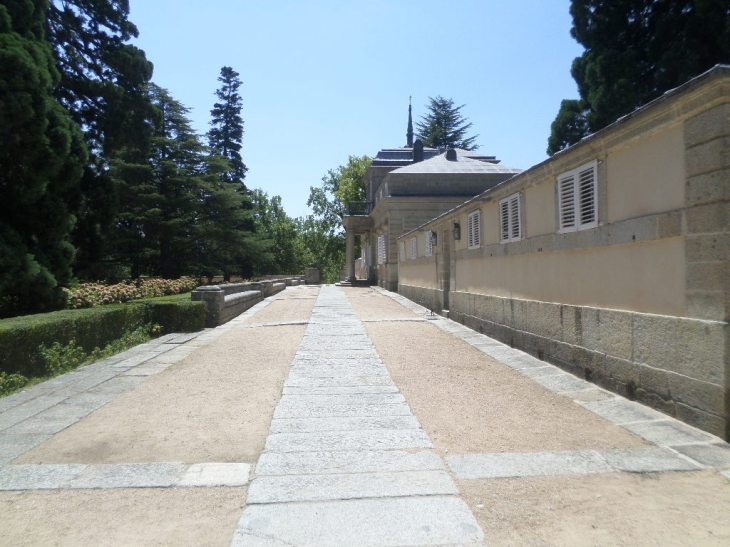
The Casita del Príncipe initially consisted of a single rectangular block, with a 27-meter façade, reminiscent of the Museo del Prado, Juan de Villanueva’s masterpiece. Between 1781 and 1784 it was enlarged with a rear wing. It has two floors. It is surrounded by two gardens, one in the front and one in the rear, connected to each other by two Tuscan columns. The palatial taste of the time is present in its fountains, ponds, waterfalls, walks and boxwood hedges. To this is added the existence of an extensive park around it, populated by native species, such as oak and encina, local species like sequoi and pinsapo; and typical garden trees.

The Casita del Principe keeps in its interior a relevant 18C decoration, representative of the palatial art of the time, in good condition. Although much of the original elements were lost during the Napoleonic invasion, King Ferdinand VII returned to decorate it. In the 20C, the furniture was restored at the initiative of Alfonso XIII. On the ground floor, the Neoclassical Ferroni decorations of Pompeian and Etruscan style, silks, upholsteries, furniture, lamps and clocks stand out. The marble stucco and ceilings were painted by Vicente Gómez, Juan de Mata Duque, Luigi Japelli, Mariano Salvador Maella and Francisco Bayeu. On the upper floor, the vaults located at a much lower height than those on the lower floor are topped with stuccoes with reliefs. It has a room completely decorated with porcelain of Buen Retiro, with taste close to the Rococo style. This house has no bedrooms, since its use was limited to enjoy them and their surroundings during the day, and not to sleep in them.

The San Lorenzo tourist office on the Casita del Principe : https://www.sanlorenzoturismo.es/visitar/casita-del-principe/casita-del-principe/
The Comunidad de Madrid on the Casita del Principe : https://www.madrid.org/monumentoscercanias/casita-del-principe.html
The National Heritage of Spain on ticketing for the Casita del Principe : https://tickets.patrimonionacional.es/es-ES/informacion-recinto/3/casita-del-principe-el-escorial
The City of San Lorenzo de El Escorial on its history : https://www.aytosanlorenzo.es/historia/
This is a marvelous house to see , the best way is to have a car , however, you can go on foot, to the Casita del Principe walk from the monastery in about 1.2 km. It has good signage to lead you to it, An opportunity to go into the wooded area and see something different from the Monastery and the town of San Lorenzo de El Escorial not to leave with a great piece of history and wonderful architecture. Again, hope you enjoy the post on the Casita del Principe as I
And remember, happy travels, good heatlh , and many cheers to all !!!

 Paris1972-Versailles2003