
Well of course from birth I was taught and made remember the plays of a giant of Spanish literature ,playwriter, and a poet that was Miguel Cervantes Saadvedra better known as Cervantes. And it is my whimsical Barrio de las Letras (see post) neighborhood in my beloved Madrid! Let me update this post when I took my boys on an educational visit for the roots of it all! Therefore, here is my take on the Casa Museum of Cervantes in Madrid !!! Hope you enjoy the post as I.
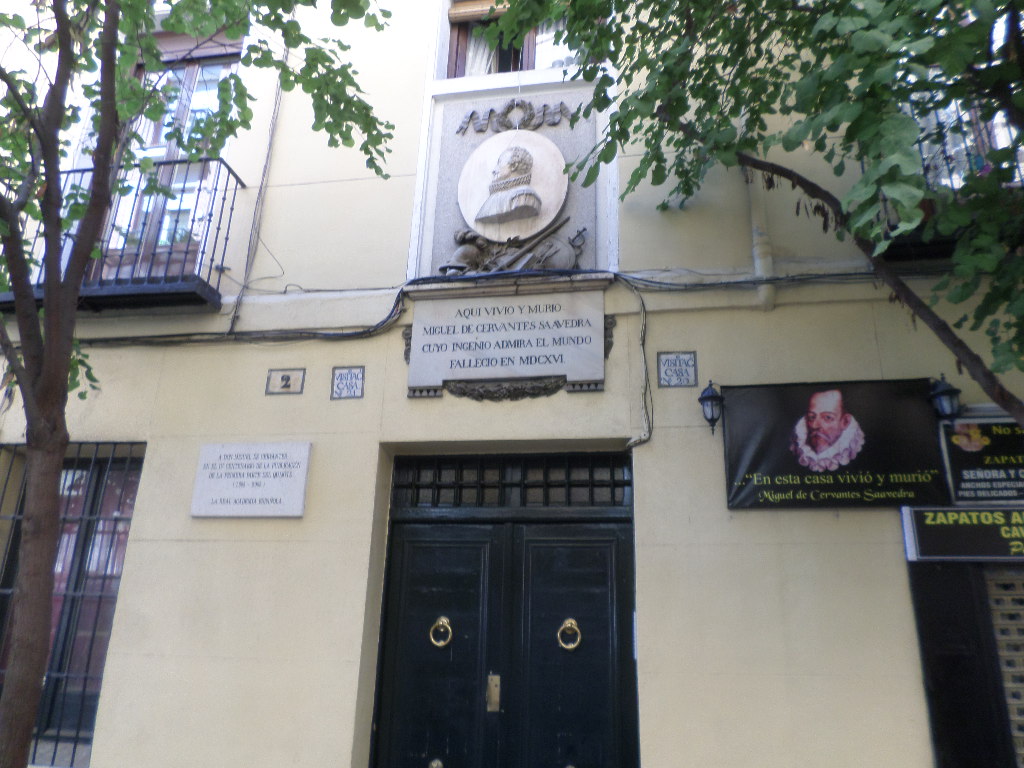
On Calle Cervantes, 2 is the last house in which Miguel Cervantes Saavedra lived in Madrid. The house is not preserved as at the time nor can it be visited. But we can see the plaque, which says: “Miguel de Cervantes Saavedra lived and died here, whose ingenuity admires the world. He died in MDCXVI. ” (1666).
In addition, we know that the novelist lived in other houses in Madrid. For example, at Calle de Huertas 18 , the same building where Casa Alberto restaurant is today, founded in 1827. A plaque next to the premises remembers it. Here he wrote the second part of El Quijote and The Works of Persiles and Segismunda. Also , he is buried in the Iglesia de las Trinitarias Descalzas (Church of the Barefoot Trinitarian) at Calle de Lope de Vega, 18. Also, the printing shop of Juan de la Cuesta on Calle de Atocha 87 is the building where the first part of El ingenioso hidalgo Don Quijote de La Mancha (The Ingenious knight Don Quijote de La Mancha) was printed. A plaque reminds us, adorned with figures of the characters of the work. At present, the building houses the Cervantes Society. Shortly after publication, in 1609, the printing moved to the neighboring Calle San Eugenio, 7 ; you can see another plaque that says that the second part of Don Quixote was printed here. The building is occupied by private homes.
The statue of Cervantes is in the Plaza de las Cortes,(see post) in front of the Congreso de Diputados (Congress). This figure, opened in 1833, represents the novelist in period dress. You saw the classic ruff in the right hand it carries a roll of papers. At the base you can see two scenes of El Quijote, carved in bronze. The monument to Cervantes located in the Plaza de España (see post) is one of the most spectacular in Madrid. Opened in 1929, it measures 35 meters high and offers great complexity due to the amount of figures it contains and its meaning.
There are many streets dedicated to Cervantes in Madrid. To him and his works, of course. The main one would be Calle Cervantes, where he lived and died. Calle Don Quijote is in the Cuatro Caminos neighborhood, and next to it is Calle Dulcinea. The street dedicated to Sancho Panza, quite short, is in Puente de Vallecas. Even shorter, a few blocks away, is the street dedicated to the bachelor Sansón Carrasco. In the neighborhood of Tres Olivos we find many others related to El Quijote: Ronda del Ingenioso Hidalgo, Cueva de Montesinos , Princesa Micomicona , Rocinante, and so on. From Atocha train Station (RENFE) , the Cervantes Train leaves, on Saturdays from April to December. The destination is Alcalá de Henares, on a non-stop route enlivened by theatrical performances. And more of Cervantes there!
The Madrid tourist office on the Casa Cervantes: https://www.esmadrid.com/en/tourist-information/cervantes-house
The official Cervantes Society: https://sociedadcervantina.es/
There you go folks, if you want to know about Spanish literature , playwrites and dwell on the history of Spain, then by all means stop by this house of Cervantes, and any other you can in Madrid or Alcala de Henares nearby. (see posts). Again, hope you enjoy on the Casa Museum of Cervantes in Madrid !!! as I.
And remember, happy travels, good health, and many cheers to all !!!

 Paris1972-Versailles2003